Pittsburgh Post-Gazette: We All Know they Need It; Boys & Girls Club Opens a New Center in the Mon Valley

There was a lot to celebrate on Fifth Avenue in McKeesport on Wednesday, as dozens of local children and community members joined the Boys&Girls Clubs of Western Pennsylvania for the opening of their new teen center.

The event was also a commemoration of 135 years of the organization’s chapter in the Pittsburgh region.


The McKeesport center is a relocation and expansion of the previous Mon Valley location, and the first new Boys&Girls Clubs opening in Western Pennsylvania since the pandemic.

The newest location is quadruple the size of the former, and characterized as “a place for teens to prepare for careers and life,” offering resources such as financial literacy courses, workforce development and mentorship, and somewhere for youth to feel secure. Financial stipends are also offered to participants, so they don’t have to worry about an after school job.

The new site was established in partnership with UPMC McKeesport and UPMC Health Plan.

Christopher Watts, former participant and current President and CEO of the Boys&Girls Clubs of Western Pennsylvania, stressed his commitment to the kids and communities of McKeesport and the Mon Valley.

“Moving forward, I just want to share that it’s our intent to work collaboratively with the community to support the kids of McKeesport, as we all know they need it,” Mr. Watts said.

The new location comes at a time when many families in the Mon Valley are struggling. In a 2021 study, the Southwestern Pennsylvania Commission reported that roughly 1 out of 3 McKeesport residents lived below the poverty line.

It’s also a time where youth participation in Boys&Girls Clubs have declined drastically nationwide – and almost 45 percent decrease since 2019.

“I feel it’s not a coincidence that we’re seeing rising challenges with teens and communities and a drop in participation rates in out of school programs,” Mr. Watts said. “What gives me hope is that the Boys&Girls Club will be a part of that solution.”

“The best part of my job is being with these kids,” said Marquise Wheeler, who’s been leading the Mon Valley center at its previous location since last year. “Our vision is to make sure our kids are showing up everyday, they’re here and they’re safe, they’re learning a thing or two and they’re having fun.”

KaNya Pitts, who has been a Club Teen since last year, said joining the program gave her a chance to go to events like Steelers games and pumpkin picking. But most importantly, she said she shows up because she feels safe.

She also praised Mr. Wheeler for his leadership and his advice.

“We’re around each other from open to close,” Ms. Pitts said.

Sha’ron Cash, who has been a club participant for several years, credited the club for changing his life.

“I used to get into a lot of trouble,” he said. “But when I started coming here, it changed my life and helped me out pretty well.”

View the full article at wesa.fm


Lehigh Valley News: Allentown, Hellertown trails get shout out as state officials kick off Commonwealth Sustainability Week

Everyone experienced the effects of climate change in some way this summer, Peter Boger said Monday afternoon.

“Whether that was smoke from the fires, or the flooding or with extreme heat,” said Boger, assistant director for outreach and engagement with Penn State Sustainability. “And we know these are going to be issues that continue to affect us here in Pennsylvania and worldwide, and yet at the same time, and this is an exciting moment of opportunity.


“There’s more money coming from the federal government around climate than ever before, and we’re seeing a lot more action at the federal, state and local levels.”

More than 150 people tuned in Monday afternoon for the first webinar of Commonwealth Sustainability Week, focused on efforts from state-level leadership to curb climate change. In its third year, and hosted by the state’s GreenGov Council and Penn State Sustainability, the weeklong event features daily, free webinars focused on climate change and sustainability efforts statewide.

“Hopefully, you see the theme — that we’re trying to raise awareness on climate and, really, our sustainability week is geared around climate actions and planning,” said Mark Hand, director of the GreenGov Council.

The webinar, “2023 Commonwealth Sustainability Week Kickoff — Sustainability Leadership,” included Cindy Adams Dunn, secretary of the Department of Conservation & Natural Resources, and Reggie McNeil, secretary of the Department of General Services. Richard Negrin, who heads the Department of Environmental Protection, was also scheduled to speak, but didn’t make the webinar. Hand said he was “tied up in another meeting.”

All serve as co-chairs for the council.

‘Cooling down the streets is critical’

The hour-long event was structured like a panel. Officials explained how their departments work to address climate change and sustainability issues before answering questions. The first question asked the panelists to share near-term climate actions that can be accomplished across the state, as well as their biggest concerns.

“Every parking lot, every rooftop I see, I feel like should have solar on it,” Dunn said. “ … So getting solar everywhere it can be, and overcoming the barriers to that policy-wise, legislatively and it costs-wise, but the investment certainly [would] be worth it in the long run.”

She also mentioned efforts to add more trees, especially in cities, where “tree cover is essential.”

“If you can get shade on streets and houses, it makes a tremendous difference in urban heat and that can save lives,” she said. “Urban heat is a killer in the summertime. So, getting our urban and suburban areas forest-covered is critical to reduce energy bills, but also to save lives and create cover

“After summer like we had, and it’s only going one direction from here right now — cooling down the streets is critical.”

Audience members were also able to submit their own questions. One asked what other state departments are working towards sustainability goals.

Closing trail gaps around the state is a major focus for other departments, including PennDOT, Dunn said. Philadelphia’s Schuylkill River Trail was built through grants, as well as funding from PennDOT and private funding, she said.

Bike commuters can use the trail “as opposed to sitting on the Schuylkill Expressway in traffic and belching exhaust.”

“In the Allentown area as well,” she continued. “There’s a link trail that’s aiming to really provide active transportation. Again, DCNR with our grants on trails has been a key partner there, as have the other agencies.”

The Link Trail connects multi-use trails across the Valley for year-round outdoor recreation and transportation.

“Getting vehicles off the road [and] getting people on trails to connect, even local errands,” she said. I was just in Hellertown a couple of years ago, when we completed a trail there, and people were using their bikes to go to the store.”

Another question dealt with severe weather events, asking if the secretaries see an opportunity to rebuild any damage using more sustainable techniques.

“If we rebuild or renovate anything, we are going to use the most energy-efficient equipment, the most green materials that are out there.”
Reggie McNeil, secretary of the state Department of General Services
“If we rebuild or renovate anything, we are going to use the most energy-efficient equipment, the most green materials that are out there,” McNeil said.

Only a handful of the more than a dozen questions submitted by the audience were answered, but Hand encouraged participants to register for future webinars throughout the week.

The schedule of webinars this week includes:

  • Preparing for a Changing Climate: Building a Resilient Pennsylvania
  • Join the Movement – PA Climate Network Participation & Training Opportunities
  • Building the Workforce of Tomorrow
  • Fostering Resilient Communities – Local Climate Action and Planning

A Lehigh Valley official is scheduled to speak as a panelist during Friday’s webinar, “Fostering Resilient Communities.”

Becky A. Bradley, executive director of the Lehigh Valley Planning Commission, is scheduled to discuss “how climate planning leads to more resilient communities.”

Other speakers include Michael Walsh, deputy secretary of the state’s Department of Conservation & Natural Resources; Lindsay A. Byron, an environmental group manager in the energy programs office of the state Department of Environmental Protection; and Cathy Tulley, environmental programs manager of the Southwestern Pennsylvania Commission.

“The session provides an opportunity to hear what state and local government planners are working on to address climate change and how we can get involved with local planning and developing local climate priorities.”

“We’ll have a great set of presenters representing a combination of state and local governments to discuss local climate action and planning,” Hand said. “The session provides an opportunity to hear what state and local government planners are working on to address climate change and how we can get involved with local planning and developing local climate priorities.”

Earlier this year, the LVPC announced the receipt of a $1 million infusion of federal funds earmarked to create two separate climate action plans over the next four years.

Officials must create a Priority Climate Action Plan, focused on industrial decarbonization, as well as a Comprehensive Climate Action Plan. The former is due March 1, while the latter is expected to be adopted in August 2025, officials said during a recent meeting of the commission’s Environmental Committee.

Register for any of this week’s webinars here. They will also be recorded and posted on the GreenGov Council’s website.

View the full article at lehighvalleynews.com


Pennsylvania Pressroom: Shapiro Administration Announces Additional Federal Electric Vehicle Charging Infrastructure Funding, Community Engagement Sessions

Today, the Pennsylvania Department of Transportation (PennDOT) announced additional conditional awards for Round 1 of the federal National Electric Vehicle Infrastructure (NEVI) funding. These awards further the Shapiro Administration’s work to address climate change, grow the Commonwealth’s economy and ensure that the future of Pennsylvania transportation is on track to be cleaner, safer, more affordable, and more reliable than ever before.


“Our work to continue investing these funds will not only help build out our electric vehicle charging network, but will create good-paying jobs across Pennsylvania,” said PennDOT Secretary Mike Carroll.

Seven projects in six counties were selected to expand access to, and the reliability of, electric vehicle charging within Pennsylvania. The nearly $3.9 million federal investment is part of the $171.5 million PennDOT will receive and distribute for electric vehicle (EV) charging infrastructure over five years through the federal Bipartisan Infrastructure Law (BIL). View the full conditional award list, by county, on the department’s NEVI web page. Additional conditional awards are as follows:

Allegheny County:

  • Applegreen Electric PA LLC: $367,749 for a charging station at the PA Turnpike service plaza in Verona (Mile 49); and
  • EVgo Services LLC: $543,960 for a charging station at Penn Place Shopping Plaza in Monroeville (I-376, Exit 84 A-B).

Chester County:

  • Applegreen Electric PA LLC: $603,294 for a charging station at the PA Turnpike service plaza in West Brandywine (Mile 305).

Clearfield County:

  • Francis Energy PA, LLC: $747,247 for a charging station at the Kwik Fill in Kylertown (I-80, Exit 133).

Fulton County:

  • Applegreen Electric PA LLC: $736,870 for a charging station at the PA Turnpike service plaza in Waterfall (Mile 172).

Lancaster County:

  • Applegreen Electric PA LLC: $498,805 for a charging station at the PA Turnpike service plaza in Bowmansville (Mile 290).

Westmoreland County:

  • Applegreen Electric PA LLC: $397,067 for a charging station at the PA Turnpike service plaza in Hunker (Mile 77).

“Working together, the Commonwealth — along with PennDOT, the PA Turnpike, and our other partners — can ensure that drivers who prefer EVs can travel anywhere in Pennsylvania without worrying about the next charging facility,” said PA Turnpike Chief Executive Officer Mark P. Compton. “Expanding availability of EV chargers will also boost interest in and sales of EVs, hastening Pennsylvania’s sustainability goals.”

PennDOT will be hosting six community engagement events around the state for community members to learn about EVs, funding options, the National Electric Vehicle Infrastructure (NEVI) Program and more. In addition, these conversations will allow community members to provide their input on where they would like to see EV charging infrastructure most in their community. The following events are currently scheduled:

Gettysburg: Oct. 16, 5:00 PM – 7:00 PM

  • Heritage Center, 297 Steinwehr Ave., Gettysburg.

Coatesville: Oct. 19, 6:00 PM – 8:00 PM

  • Graystone Mansion/Harcum College Coatesville, 53 S. First Ave., Coatesville.

Williamsport: Oct. 23. 5:00 PM – 7:00 PM

  • Michael Ross Event Center, 144 W. Third St., Williamsport.

Erie: Nov. 1, 5:00 PM – 7:00 PM

  • H.O. Hirt Auditorium at Blasco Library, 160 E. Front St., Erie.

Reading: Nov. 2, 6:00 PM – 8:00 PM

  • Goggleworks, 201 Washington St., Reading.

Pittsburgh: Nov. 8, 6:00 PM – 8:00 PM

  • Southwestern Pennsylvania Commission (SPC), 42 21st St., Pittsburgh.

To register for a community engagement event, visit this link.

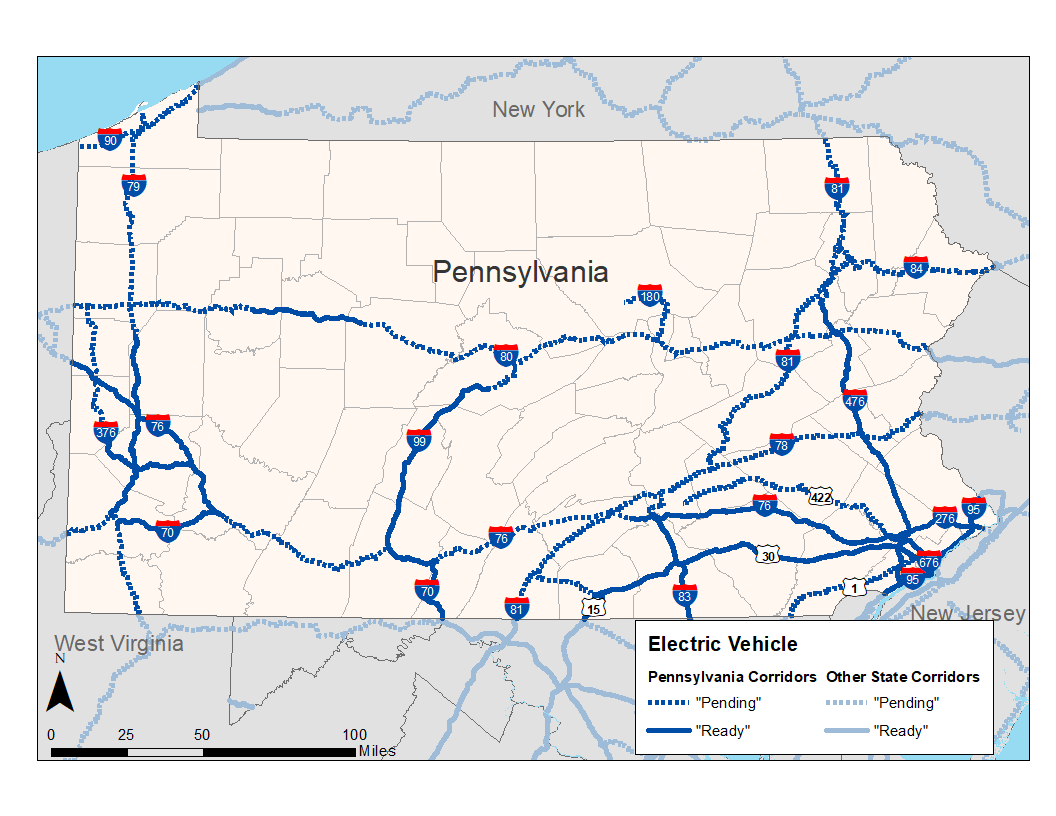
The NEVI funding supports the Commonwealth and federal goal of expanding EV charging along the previously designated Alternative Fuel Corridors (AFCs) (see a list of AFCs here) and Interstate lookalikes. Pennsylvania has over 1,800 miles of AFCs. Per guidance from U.S. DOT, NEVI formula funds must first be used to “build out” designated AFCs (meaning there must be no more than 50 miles between stations and less than 1 mile from an AFC exit) and meet U.S. DOT minimum standards and requirements.

The PA NEVI program includes multiple rounds of funding. During Round 1 selection, the focus was on building out the AFC network along the interstates to meet the NEVI requirements. Once AFCs are fully built out, PennDOT will shift to expanding the NEVI Formula Program funding to fund right-sized EV chargers for Pennsylvania’s community charging.

While Round 1 NEVI projects progress, PennDOT continues meeting federal deadlines for additional funding rounds and working toward closing all AFC gaps while expanding community charging access. Round 1 and 1a will focus exclusively on the AFC network. The department anticipates opening Round 1a later this fall with approximately $22 million available. Later this month, PennDOT will release a map showing current gaps along the AFC network to help applicants prepare for Round 1a.

For more information on NEVI funds in Pennsylvania visit the PennDOT website.

Pennsylvania can compete for billions of dollars in federal funds across a wide range of federal grant programs through the BIL, also known as the Infrastructure Investment and Jobs Act (IIJA). To help communities and organizations learn about these opportunities, PennDOT created a web page, www.penndot.pa.gov/IIJA, with details on federal grant opportunities to help municipalities, townships, and other community agencies with understanding the multiple transportation program grants that are available. The page includes Grant Alerts, guides, and links to important resources for local municipalities and organizations interested in pursuing federal funding opportunities

Information about state infrastructure in Pennsylvania, including completed work and significant projects, is available at www.penndot.pa.gov/results. Find PennDOT’s planned and active construction projects at www.projects.penndot.gov.

Subscribe to local PennDOT news or statewide PennDOT news on the department’s website.

Follow PennDOT on Twitter and like the department on Facebook and Instagram.

View the full article at media.pa.gov/


PA Environmental Digest: PennDOT To Hold 6 Regional Outreach Sessions On Electric Vehicle Charging And How EVs Can Best Fit In Your Community

PennDOT wants to hear from you on your community and business needs for electric vehicle charging as part of the National Electric Vehicle Infrastructure Program.

They have scheduled a series of six regional outreach sessions so communities and businesses can learn more about electric vehicle initiatives and funding opportunities and so participants can provide feedback on EVs and the needs of your community.


The outreach sessions will be held—

October 16:
Gettysburg Heritage Center
297 Steinwehr Ave, Gettysburg
5:00 to 7:00 p.m.

October 19:
Graystone Mansion/Harcum College Coatesville
53 S. 1st Avenue, Coatesville
6:00 to 8:00 p.m.

October 23: Michael Ross Event Center
144 W 3rd St, Williamsport
5:00 to 7:00 p.m.

November 1:
H. O. Hirt Auditorium at Blasco Library
160 E Front Street, Erie
5:00 to 7:00 p.m.

November 2:
Goggleworks
201 Washington Street, Reading
6:00 to 8:00 p.m.

November 8:
Southwestern Pennsylvania Commission
42 21st Street, Suite 101, Pittsburgh
6:00 to 8:00 p.m.

Click Here to register and for more information.

Visit PennDOT’s National Electric Vehicle Infrastructure webpage for more information.

View the full article at paenvironmentdaily.blogspot.com


Pittsburgh Post-Gazette: People on the Move

The Southwestern Pennsylvania Commission hired Caitlin O’Connor as director of public relations and communication initiatives, and DJ Ryan as director of strategic initiatives and policy.

View the full article at post-gazette.com


Robotics 24/7: Engage with the Future of Robotics and AI at Pittsburgh Robotics Discovery Day

The Pittsburgh Robotics Network invites you to step into the heart of the Robotics Capital of the World at Pittsburgh Robotics Discovery Day. Taking place on Thursday, November 16, 2023, at the David L. Lawrence Convention Center, the event is a must-attend for anyone curious about the robotics, automation, and artificial intelligence (AI) technologies that are revolutionizing our world.


“We’re looking forward to showcasing the incredible talent and innovation that exists in the Pittsburgh region. Pittsburgh Robotics Discovery Day is more than just an event; it’s an interactive opportunity for attendees to engage with the trailblazers in robotics and AI, discover how these technologies are shaping our everyday lives, and discover ways they can be a part of building our future” said Jenn Apicella, Interim Executive Director of the Pittsburgh Robotics Network.

The event promises to be an illuminating experience featuring live demonstrations of robots and AI technologies that are changing the way we live, move, and work. Open to the public and free to attend, it will be a gathering space for tech aficionados, business professionals, students, and anyone curious about the advancements in robotics and AI. There will be multiple zones to explore, including:

Robotics Zone
Attendees will experience up-close the wide variety of groundbreaking robotics and AI technologies being developed by the 100+ robotics companies in the Pittsburgh region, with on-site demonstrations, helping all to better understand their purpose and potential. Engage with the visionaries behind these pioneering advancements and experience immersive demonstrations that reveal the potential of this technology in your work and in your life.

Career Pathways Zone
Step into a multitude of educational and training resources available in the region. Whether you are already a tech professional or are entirely new to these fields, a career in robotics could be in your future. Learn why the world’s best tech talent hails from, and is attracted to, Pittsburgh.

Community Zone
Discover the nonprofit organizations, business development resources, and STEM partners that are integral to Pittsburgh’s world-leading robotics cluster.

After a highly successful inaugural event in 2022, which saw more than 4,500 attendees engage with over 80 exhibitors, Pittsburgh Robotics Discovery Day is slated to be more impactful in 2023. This year, the event will expand to include more demonstrations and an additional 42,000 square feet of exhibitor space. Additional exciting announcements are planned as the event draws closer.

“Pittsburgh is a recognized global leader in robotics and artificial intelligence, and this event opens this work up to the public, and invites all to engage with and be a part of this innovative and dynamic community,” added Apicella. “This is also an opportunity for businesses to find strategic partners, students and job seekers to connect with a variety of career and training programs, investors to identify growing startups, and so much more. It’s all happening at Pittsburgh Robotics Discovery Day.”

Pittsburgh Robotics Discovery Day is an initiative led by the Pittsburgh Robotics Network in partnership with the Southwestern Pennsylvania Commission and the Allegheny Conference on Community Development. The event is supported by the Southwestern Pennsylvania New Economy Collaborative as part of a $62.7 million Build Back Better Regional Challenge grant from the U.S. Economic Development Administration.

Event Details
Date: Thursday, November 16, 2023
Location: David L. Lawrence Convention Center, Pittsburgh, PA
Registration: Free and open to the public. To register, visit robopgh.org/discoveryday
The Pittsburgh Robotics Network encourages all attendees to register in advance, as the event is expected to attract a large audience.

View the full article at robopgh.org


New Castle News: Frye gives update on paving, street lights in city

Those driving around New Castle, particularly downtown, may have noticed traffic lights are being installed on power poles.

According to city Administrator Chris Frye, the reason for this is simple — it’s the way of the future, at least according to PennDOT. Penn-DOT and the Southwestern Pennsylvania Commission are working to gradually replace all traffic lights over the next year with the lights on the poles.


“They’re trying to do away with stop lights on hanging wires,” Frye said.

Frye said more details on the stop lights will be released in the future by PennDOT and the SPC.

Frye also gave an update on paving work as part of the 2023 paving project.

The city is spending nearly $1.2 million on paving this year to be done by Wampum-based Youngblood Paving.

The streets paved so far are Blaine Street, East Northview Avenue, Fairmont Avenue, Glendale Avenue, Moody Avenue, Sheridan Avenue, areas on Croton, Cascade Street, Laurel Place and Dewey Avenue, with Frye noting there is an area on East Northview Avenue that Youngblood has to fix.

The streets that are marked and ready to be milled and paved are Lacock Street, 3rd Street, Almira Avenue, Frank Avenue, Gibson Avenue, Hazel Avenue, Vogan Avenue, Williams Street and South Jefferson Street.

Streets that still need to be marked for paving work are Cumberland Avenue, East Miller Avenue, Lawrence Street and East Lutton Street.

Frye said People’s Natural Gas is currently doing work on Emery Street, Englewood Avenue, Fairfield Avenue, McCleary Street and North Mercer Street, while the company will pave Carlisle Avenue from Euclid Avenue to Clen Moore Boulevard.

He also said planned paving work on East North Street, East Terrace Avenue, Marshall Avenue and West Chartes Street had to be removed due to planned gas company work in the future.

View the full story at ncnewsonline.com


SPC Releases Southwestern Pennsylvania Regional Climate Pollution Reduction Plan RFP

The Southwestern Pennsylvania Corporation, a 501(c)(3) corporation, on behalf of the Southwestern Pennsylvania Commission (SPC), is requesting Technical Proposals and Price Proposals (together, Proposal packages) for obtaining consultant services to assist with the development of the “Southwestern Pennsylvania Regional Climate Pollution Reduction Plan.”


The selected firm or team of firms will assist SPC with developing a two-part plan consisting of a regional Priority Climate Action Plan (PCAP) and a Comprehensive Climate Action Plan (CCAP). The “Southwestern Pennsylvania Regional Climate Pollution Reduction Plan” will assist the region in understanding and addressing the sources of climate pollution and emissions, and will produce an actionable plan with high-priority projects that will proactively address these issues for the region’s residents.

The Request for Proposals (RFP) was released by SPC on August 30, 2023. Copies may be downloaded from the SPC Website (www.spcregion.org) or may be obtained by e-mail request to Catherine Tulley at ctulley@spcregion.org.
 
Electronic submissions will be required via SPC’s SharePoint site. Full submission details are provided in the RFP document. Proposal packages are due on October 2, 2023.
 
Click HERE to access RFP Download documents


Technical.ly: A year later, what progress has the Pittsburgh Digital Equity Coalition made?

The group made up of a dozen-plus nonprofits and institutional partners has been listening to residents’ feedback and making plans to gather more data. Next up: a five-year plan to close the digital divide.

In April 2022, the Southwestern Pennsylvania Commission reported that residents in Allegheny County have both some of the highest internet speeds in the region and areas with inadequate internet speeds or few service options.


In response, this time last year, the newly minted Gainey administration announced a renewed commitment to helping Pittsburgh close the digital divide by 2027.

To do this, Mayor Ed Gainey and County Executive Rich Fitzgerald explained while standing in front of the City-County Building, a coalition of a dozen-plus nonprofits, institutional partners and technologists had been assembled to create a five-year plan to ensure that connectivity wasn’t something that only the most well-off Pittsburghers can afford.

That group’s name: the Pittsburgh Digital Equity Coalition.

“Today we break down silos and commit to a partnership to end the digital divide in our region by 2027,” Gainey said during a press event launching the initiative last September. “Our transformation to an eds and meds economy, one that drives technological advances in robotics and medical engineering, will not leave anyone behind.”

In the year since this declaration, what progress has been made by the coalition?

Heidi Norman, the director of the City of Pittsburgh’s Department of Innovation and Performance who was a part of the coalition’s announcement, referred Technical.ly to Jennifer Blatz, program director of coalition member Greater Pittsburgh Digital Inclusion Alliance. According to Blatz, the makeup of the coalition hasn’t changed. However, progress on the group’s stated goal to develop a five-year plan to close the digital divide by Q2 2023 is delayed. Blatz said so far, the group has mainly collected feedback from residents on their digital needs, which will then inform the creation of that plan.

“Over the summer, we started doing community feedback sessions, listening sessions, to essentially solicit more specific needs from community members that were assembled,” Blatz said.

What coalition members have been hearing from session attendees, she said, is that affordability is a pressing issue for Allegheny County residents. They have also heard concerns about accessibility of devices and skills for older adults — concerns shared by residents across Pennsylvania. (These concerns are also addressed by the Pennsylvania Broadband Development Authority’s new five-year action plan released earlier this month to direct the allocation of the state’s federal Broadband Equity Access and Deployment funds.)

Yet she said it’s helpful that while the coalition finalizes its recommendations, there are programs that already exist to fill in the gaps.

“Fortunately in Allegheny County, we do have a number of internet service providers,” Blatz said. “But the cost associated with high-speed internet service is still just out of reach for a lot of households.”

In addition to listening, the coalition has started writing the five-year plan. Since it’s a work in progress, Blatz said many facets of the plan can’t be shared with the public yet. Still, she did share that the coalition is currently trying to obtain more data to inform the decisions the mayor and county executive make with regard to digital equity.

“Theoretically, people are taking advantage of ACP [Affordable Connectivity Program] and more households are getting connected,” Blatz said, referring to the $14.2 billion federal benefits program that provides a $30 subsidy for internet service to eligible families. “But we want to verify that. So we are pursuing some avenues to hopefully secure funding to update that data.”

For the time being, the Pittsburgh Digital Equity Commission remains in a state of listening, data gathering and discussing, but ultimately, Blatz feels they’re on track for a productive future.

“It’s exciting, we’re very happy with the participation of all of the partners and our progress,” she said. “2024 is going to be a very big year for digital equity and inclusion for all of us.”

Atiya Irvin-Mitchell is a 2022-2023 corps member for Report for America, an initiative of The Groundtruth Project that pairs young journalists with local newsrooms. This position is supported by the Heinz Endowments.

View the full article at technical.ly


Pittsburgh Post-Gazette: Lawrence County joined to Allegheny for federal funds and commuting patterns

In a surprise to officials, the county now is part of the Pittsburgh Metropolitan Statistical Area.

The Pittsburgh Metropolitan Statistical Area just got a little bigger.

Lawrence County, which includes the city of New Castle, recently was added to the MSA, joining Allegheny, Armstrong, Beaver, Butler, Fayette, Washington and Westmoreland counties.


Lawrence, about an hour north of Pittsburgh, is west of Butler County and north of Beaver County along the Ohio border. Its addition to the Pittsburgh MSA — the first since Armstrong County was brought in two decades ago — increases the area’s population by more than 85,000 residents.

The designation matters.

Some federal programs, such as community development block grants and climate reduction pollution funding, involve allocations by MSAs. In addition, some businesses may focus on metropolitan statistical areas when they decide where to locate or expand.

Just how the decision was made? That’s not so clear.

The move to add Lawrence was done by the White House Office of Management and Budget. The office didn’t respond to requests for comment.

Nor has anyone from OMB contacted the county, according to Dan Vogler, chair of the Lawrence County commission.

“We have not been given any official notification,” Mr. Vogler said. “It’s obvious they’ve done it but we have not received anything.”

The U.S. Census Bureau says counties are added to MSAs because of new commuting or urban population data. There were 387 metropolitan statistical areas across the country as of July.

Lawrence County has attracted some people who work in Downtown Pittsburgh, the North Hills or southern Butler County, attracted by lower housing costs and an easy commute via three interstate highways, Mr. Vogler said.

“We do have people who live here and commute,” he said. “On some of the back roads, there have been a lot of nice new homes built over the last couple of decades. I don’t know where those people work but my assumption is some people move out here to get away from the congestion and get a bigger house for less money.”

Lawrence County already is linked to Allegheny County, which includes Pittsburgh, through its inclusion in the Southwestern Pennsylvania Commission, a metropolitan planning organization that helps direct how state and federal transportation and development funds sent to the region are spent.

But the county also is part of the Northwest Commission, which focuses on economic development in Lawrence and eight counties in the northwestern part of the state. Mr. Vogler chairs the commission.

He said county officials welcome the new designation, saying it could help attract new businesses such as factories or warehouses.

“We view it as very positive for Lawrence County and for the future,” he said. “One of the potential positive benefits is, when developers and site selectors are looking at potential areas in which to locate, my assumption is in some cases, they may only look to locate within an MSA. If that is the case, by adding us to the Pittsburgh MSA, that enhances our opportunity for potential new development.”

View the full story at post-gazette.com