Statement from Vincent Valdes on the passing of Richard Hadley

It was another sad day in Southwestern Pennsylvania with the passing of Cranberry Supervisor and SPC Commissioner Richard Hadley,” said Vincent Valdes, SPC Executive Director. Commissioner Hadley represented Butler County on the Commission since 2015. He was dedicated to real-world planning and championed mixed use and complete streets policies for Cranberry Township as a long-time township supervisor. He brought his passion for planning to SPC’s regional forum and we will miss his expertise on how to plan for growing communities. Every day, the residents of Cranberry Township are witness to and of his life-long, dedicated public service.

Vincent Valdes

https://www.butlereagle.com/20220825/longtime-cranberry-supervisor-chairman-dies-2/


An Update on SPC’s Regional Freight Plan (and Why It’s Important!)

By Mason Fish
SPC
10/29/2025

The way goods move across Southwestern Pennsylvania shapes nearly every part of daily life, from how grocery stores stay stocked to how local industries get their products to the market. Behind the scenes, freight networks connect the region’s roads, railways, airports, and waterways into one complex system that keeps the economy running. That constant, mostly unseen movement is one of the reasons our region works, and it is why updating the Regional Freight Plan matters.


The Southwestern Pennsylvania Commission (SPC) adopted its first Regional Freight Plan in 2017. At the time, the plan helped set priorities for maintaining and improving the systems that move goods across the 10-county region that the organization serves. But in the years since, the world has changed dramatically. Supply chains have been reshaped, consumer habits have shifted, shippers have adapted, and the local economy has continued to evolve from where it was a decade ago.

Therefore, SPC is now leading an update to the Regional Freight Plan, in order to make sure the region can keep goods moving efficiently and safely for years to come!

While freight can seem like a technical subject, the core idea behind the plan is simple. Freight is about how things get where they need to go. From raw materials to finished products, the freight network touches nearly every aspect of daily life.

“We like to think of our freight network as a system… a highway system supported by a rail network, supported by rivers, supported by an airport. They all have to work together,” said SPC Freight Planning Manager Sara Walfoort.

When it works well, businesses can grow, communities are supplied, and the region stays economically connected. When it struggles, everyone feels the effects. Southwestern Pennsylvania is unique when it comes to freight movement. The region’s geography, history, and industrial makeup have created a truly multi-modal network. Many places in the U.S. rely almost entirely on trucking, but in our region, the network has always been broader.

The region has:

  • 18 active railroads; approximately 30 percent of the railroads in PA;
  • Over 1,300 miles of rail lines within the 10 counties SPC serves;
  • One of the busiest inland river ports in the country, historically ranking among the top nationally when measured by tonnage;
  • A highway system that connects to major population centers and industrial corridors; and
  • Air cargo capacity that supports high-value, time-sensitive products.

This diversity matters, and different modes of transportation serve different needs. Heavy commodities like coal, steel inputs, or construction aggregates can move efficiently by river barge. High-value or urgent products, such as medical components or electronics, may move by air. Trucks are essential for reaching the thousands of communities that rail and river terminals don’t directly serve. Rail is critical for long-haul shipments and energy supply. When all of these systems work together, companies have options which allows the region to maintain a competitive advantage.

However, this system only works if it is maintained, modernized, and coordinated. A closed lock on a river, for example, can shift freight onto trucks, sending thousands of additional heavy vehicles onto roadways. Congestion on a key highway can slow deliveries. Rail bottlenecks can hold up shipments across multiple states. And when one part of the network becomes strained, the whole system feels the impact.

That is where the updated Regional Freight Plan comes in. This document will take a clear look at how goods actually move through our region today, mapping out the roads, railways, river facilities, and other key connections that form the backbone of the network. It will highlight where strategic investments could improve safety and reliability, while also supporting more efficient movement of goods.

While SPC is not a freight operator and doesn’t run trains, barges, or fleets of trucks, it does play a central role in planning, investment prioritization, and coordination. The updated plan will serve as a bridge between public agencies, private industry, and the broader community, ensuring that decisions are made with a clear understanding of how the freight network works and what the region needs next.

“I want to move to a more systems-based approach, looking at roadway condition, track history, bottlenecks, and how trucks traverse roads… so we can invest freight improvement dollars wisely,” said Walfoort.

The updated plan is expected to be delivered by June 2027, with a focus on making targeted improvements across the region’s transportation network. 

The hope for this new blueprint is to help SPC prioritize investments that strengthen the network as a whole rather than addressing issues in isolation. The plan will assess things such as essential corridors and facilities to identify constraints, reduce delivery delays, improve safety, and help businesses get products to market more efficiently. Better coordination among freight modes could lower transportation costs, support economic growth, and ensure the region remains competitive.

The update also aligns closely with SPC’s Long Range plan and with the Pennsylvania 2045 Freight Movement Plan adopted at the state level. By keeping these plans synced, SPC helps ensure that regional priorities are recognized and funded at the state and national levels.

To make the updated freight plan meaningful, SPC is focusing not only on data and infrastructure, but also on communication and public understanding. Many people fail to realize how closely freight is tied to economic opportunity, community stability, and quality of life. This newsletter is one part of that effort in helping connect the dots between freight movement and daily life.

At the end of the day, it’s about supporting the future of the region’s economy, from job creation to infrastructure investment to keeping everyday goods moving where they’re needed. Freight touches everything, even if most of the work happens out of sight.

As the update progresses, SPC will share opportunities to learn more and participate. Whether you work in logistics, manufacturing, retail, healthcare, or just shop for groceries, the freight network helps ensure products reach homes, businesses, and communities across the region.


Indiana Gazette: Indiana County marks 9/11, suicide prevention, alternative travel and the Constitution

The Indiana County Board of Commissioners approved four proclamations Wednesday.

  • On the anniversary of the Sept. 11, 2001, terrorist bombings, one proclamation designated Indiana County as a Green Light for Veterans county, honoring “the service and sacrifices of our men and women in uniform who have transitioned or will transition from active service.”

Indiana County’s new Director of Veterans Affairs Jessica Walker said 9/11 “ultimately changed the course of this country, changed my life and changed my husband’s life.” She said 5,000 veterans now live in Indiana County.


Commissioner Sherene Hess said a cousin in Centre County, Adam Hartswick, “is now a mentor to others,” after losing his legs in the explosion of an improvised explosive device in Iraq in 2013. “He was barely over 18,” Hess said. “He came back to join a program where he would mentor others.”

  • On the eve of an annual “Walk for a Wonderful Life,” a proclamation was approved marking Sept. 8-14 as Suicide Prevention Week, recognizing “suicide as a public health problem, and suicide prevention as a community responsibility.”

The week ends with the 12th annual Walk for a Wonderful Life Sunday in Mack Park, a fund-raising event which Indiana County Suicide Task Force Co-Chair Chelsey Baroni said is being expanded this year, beyond advertising now run on the radio, billboards and masks.

  • Another proclamation marked National Transportation Demand Management week, marking how strategies are used “to inform and encourage travelers to maximize the efficiency of a transportation system leading to improved mobility, reduced congestion and lower vehicle emissions.”

Receiving the proclamation was Ronda Craig, public involvement coordinator for the Southwestern Pennsylvania Commission, a regional organization that helps local governments access state and federal funding for transportation and economic development projects in 10 counties around Pittsburgh, including Indiana, Armstrong and Westmoreland.

  • A fourth proclamation marked Constitution Week from Sept. 17 to 23, including Sept. 17 which is the 237th anniversary of the framing of the Constitution of the United States, “the guardian of our liberties,” which “embodies the principles of limited government in a republic dedicated to rule by law.”

Receiving the proclamation were Indiana County Daughters of the American Revolution Regent Debbie Bier and Past Regent Darla Mechling.
 
Bier said the DAR campaigned for a week marking the Constitution in the 1956, when a law marking Constitution Week was signed by President Dwight D. Eisenhower.
 
Bier said work has been going on for more than a year on a plaque that will honor patriots buried in Indiana County. She said 141 patriots have been found so far.
 
In other business Wednesday, the commissioners approved reappointment of John Somonick and John German to the board of Indiana County Parks & Trails for terms to expire in August 2019.
 
They also approved the reappointments of Indiana County Chamber of Commerce President Mark Hilliard, Wright-Knox Motor Lines President Gladys Knox and Nelson & Associates Insurance Director of Operations Jack Nelson to the Tri-County Workforce Development Board for terms expiring in September 2027.
 
They authorized an application on behalf of the District Attorney’s Office for the 2025 Rights and Services Act Grant, seeking $71,151, most of which will cover salary and benefits for a full-time victim witness coordinator, as well as $641 for training for a victim service staff and $1,213 for office supplies.
 
And they approved multiple requests for Indiana County Children and Youth Services, including a 2024-25 non-placement listing for Justice Works Youthcare in Wilkinsburg, Allegheny County, to be facilitator and host for Act 33 child fatality/near fatality review meetings at a rate of $450 per meeting.
 
Also for CYS, 2024-25 foster care placement listing renewals were approved for:

  • Family Cares for Children and Youth in Milton, Northumberland County.
     
  • LifeSpan Family Services in Punxsutawney.
     
  • Professional Family Care Services Inc. in Johnstown.
     
    Also approved were group home placements for 2024-25 with:
     
  • Pentz Run Youth Services Inc. in DuBois for its Supervised Independent Living and Transitional Living programs.
     
  • George Junior Republic in Pennsylvania, in Grove City, for males ages 10-21.

Also approved for CYS was a new contract for 2024-25 with Altior Healthcare-Innercept of Los Angeles, Calif., providing a residential setting for drug and alcohol and mental health treatment for teenage youth at a location in Idaho.

View the full article at indianagazette.com.


PGH Business Times: Region reacts to potential Dallas-Pittsburgh-New York Amtrak service

A potential Amtrak line that would connect Pittsburgh with St. Louis, Oklahoma City and Dallas/Fort Worth for the first time in more than a generation generated positive interest in the past few days since it was unveiled.

The Federal Railroad Administration said this week that it was in the early stages of studying a handful of possible future Amtrak routes that would need both capital and operating money to become a reality. One would connect Detroit with New Orleans; the other would connect Dallas/Fort Worth with New York and include Pittsburgh along with other cities along the route.


Rich Fitzgerald, executive director of the Southwestern Pennsylvania Commission and former longtime Allegheny County executive, thinks the rail line will have an impact if it becomes a reality.

“There’s no question anything we can do to connect the region to other parts of the country and other parts of the world helps the economic climate,” Fitzgerald said. “It would be pretty positive.”

Western Pennsylvanians for Passenger Rail, a group of passengers who have long advocated for additional Amtrak service in the Pittsburgh region, say they’re interested, too.

“This proposal could restore much of a route previously operated by Amtrak with its National Limited train until 1979,” WPPR told the Business Times in an email. “Additionally, this proposed route has a segment that overlaps another study being conducted by the Mid-Ohio Regional Planning Commission, which is evaluating the feasibility of a new passenger rail route connecting Chicago with Columbus and Pittsburgh.”

Also interested is VisitPittsburgh.

“News of the potential new Amtrak route presents an exciting opportunity for Pittsburgh’s tourism sector,” said Emily Hatfield, a spokeswoman for the tourism marketing organization. “Allegheny County welcomes 19.5 million visitors each year, and the proposed Dallas train would provide expanded connectivity into our region and allow us to grow our visitor base.”

Fitzgerald said that a long trip on the train from Pittsburgh to Dallas might not appeal to the business traveler when the flight will take about two hours.

“But there will be many stops and many connections along the way,” he said. “It might not be the connection from Pittsburgh to Dallas but to other cities, like Oklahoma City, Columbus, Cincinnati, other places that could be connected by rail,” Fitzgerald said.

The Allegheny Conference on Community Development said that it appreciates the potential federal investment in proposed Amtrak routes and the connectivity and transportation options. A spokesman told the Business Times that at this moment, the Dallas-Pittsburgh route would have a significant impact as an asset of economic development.

“It certainly could be beneficial for tourism as another way to get more people, by rail, to our city and region to experience all it has to offer and spend their leisure travel dollars here,” conference spokesman Phil Cynar said.

The Pennsylvania Department of Transportation would have to be involved in the effort but told the Business Times it is aware of the potential but has limited involvement.

“PennDOT supports the expansion of passenger rail as a mobility option for travelers through Pennsylvania and beyond,” said PennDOT spokeswoman Alexis Campbell.

One of the focuses of SPC is in transportation, and Fitzgerald sees not just the mainline connections between New York and Dallas through Pittsburgh as a positive but the potential shorter connections that might come out of it for cities like Uniontown, Pennsylvania, and Morgantown, West Virginia. He said SPC would be active in supporting more rail service for southwestern Pennsylvania.

“If they are going to be appropriating that type of funding to connect these various locations across the country, yes, the SPC will be an important and big player,” Fitzgerald said.

Read the full article at bizjournals.com.


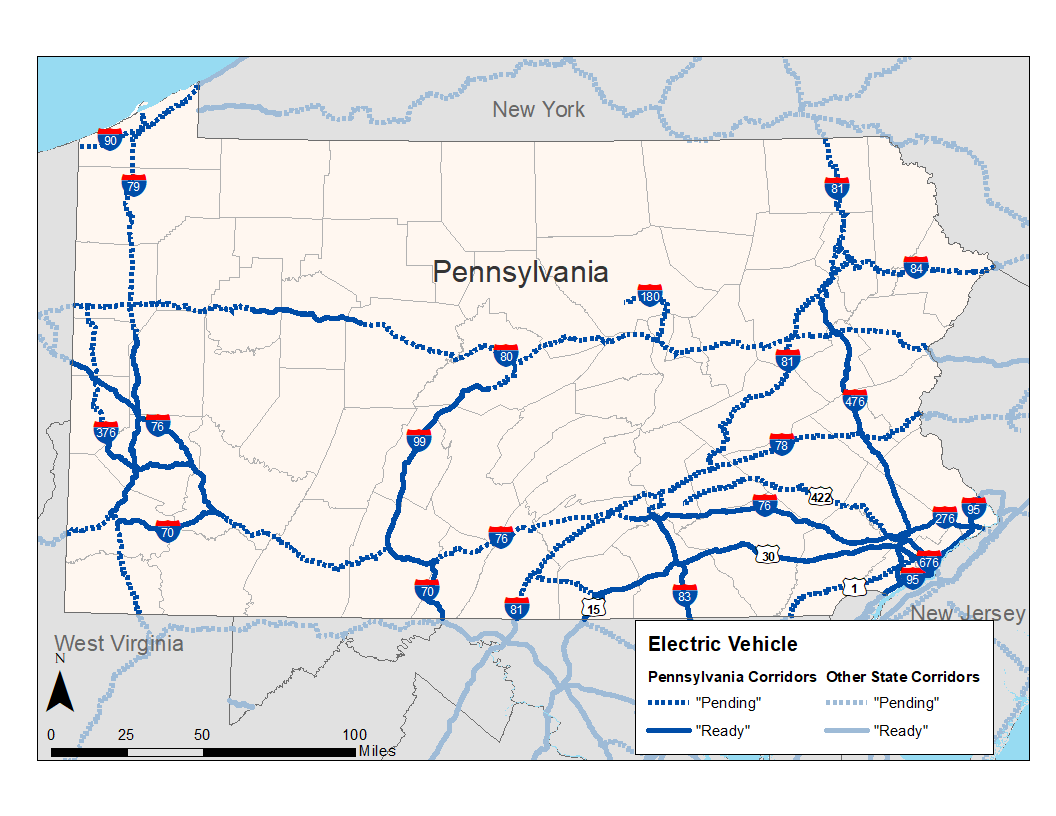
Pennsylvania Pressroom: Shapiro Administration Announces Additional Federal Electric Vehicle Charging Infrastructure Funding, Community Engagement Sessions

Today, the Pennsylvania Department of Transportation (PennDOT) announced additional conditional awards for Round 1 of the federal National Electric Vehicle Infrastructure (NEVI) funding. These awards further the Shapiro Administration’s work to address climate change, grow the Commonwealth’s economy and ensure that the future of Pennsylvania transportation is on track to be cleaner, safer, more affordable, and more reliable than ever before.


“Our work to continue investing these funds will not only help build out our electric vehicle charging network, but will create good-paying jobs across Pennsylvania,” said PennDOT Secretary Mike Carroll.

Seven projects in six counties were selected to expand access to, and the reliability of, electric vehicle charging within Pennsylvania. The nearly $3.9 million federal investment is part of the $171.5 million PennDOT will receive and distribute for electric vehicle (EV) charging infrastructure over five years through the federal Bipartisan Infrastructure Law (BIL). View the full conditional award list, by county, on the department’s NEVI web page. Additional conditional awards are as follows:

Allegheny County:

  • Applegreen Electric PA LLC: $367,749 for a charging station at the PA Turnpike service plaza in Verona (Mile 49); and
  • EVgo Services LLC: $543,960 for a charging station at Penn Place Shopping Plaza in Monroeville (I-376, Exit 84 A-B).

Chester County:

  • Applegreen Electric PA LLC: $603,294 for a charging station at the PA Turnpike service plaza in West Brandywine (Mile 305).

Clearfield County:

  • Francis Energy PA, LLC: $747,247 for a charging station at the Kwik Fill in Kylertown (I-80, Exit 133).

Fulton County:

  • Applegreen Electric PA LLC: $736,870 for a charging station at the PA Turnpike service plaza in Waterfall (Mile 172).

Lancaster County:

  • Applegreen Electric PA LLC: $498,805 for a charging station at the PA Turnpike service plaza in Bowmansville (Mile 290).

Westmoreland County:

  • Applegreen Electric PA LLC: $397,067 for a charging station at the PA Turnpike service plaza in Hunker (Mile 77).

“Working together, the Commonwealth — along with PennDOT, the PA Turnpike, and our other partners — can ensure that drivers who prefer EVs can travel anywhere in Pennsylvania without worrying about the next charging facility,” said PA Turnpike Chief Executive Officer Mark P. Compton. “Expanding availability of EV chargers will also boost interest in and sales of EVs, hastening Pennsylvania’s sustainability goals.”

PennDOT will be hosting six community engagement events around the state for community members to learn about EVs, funding options, the National Electric Vehicle Infrastructure (NEVI) Program and more. In addition, these conversations will allow community members to provide their input on where they would like to see EV charging infrastructure most in their community. The following events are currently scheduled:

Gettysburg: Oct. 16, 5:00 PM – 7:00 PM

  • Heritage Center, 297 Steinwehr Ave., Gettysburg.

Coatesville: Oct. 19, 6:00 PM – 8:00 PM

  • Graystone Mansion/Harcum College Coatesville, 53 S. First Ave., Coatesville.

Williamsport: Oct. 23. 5:00 PM – 7:00 PM

  • Michael Ross Event Center, 144 W. Third St., Williamsport.

Erie: Nov. 1, 5:00 PM – 7:00 PM

  • H.O. Hirt Auditorium at Blasco Library, 160 E. Front St., Erie.

Reading: Nov. 2, 6:00 PM – 8:00 PM

  • Goggleworks, 201 Washington St., Reading.

Pittsburgh: Nov. 8, 6:00 PM – 8:00 PM

  • Southwestern Pennsylvania Commission (SPC), 42 21st St., Pittsburgh.

To register for a community engagement event, visit this link.

The NEVI funding supports the Commonwealth and federal goal of expanding EV charging along the previously designated Alternative Fuel Corridors (AFCs) (see a list of AFCs here) and Interstate lookalikes. Pennsylvania has over 1,800 miles of AFCs. Per guidance from U.S. DOT, NEVI formula funds must first be used to “build out” designated AFCs (meaning there must be no more than 50 miles between stations and less than 1 mile from an AFC exit) and meet U.S. DOT minimum standards and requirements.

The PA NEVI program includes multiple rounds of funding. During Round 1 selection, the focus was on building out the AFC network along the interstates to meet the NEVI requirements. Once AFCs are fully built out, PennDOT will shift to expanding the NEVI Formula Program funding to fund right-sized EV chargers for Pennsylvania’s community charging.

While Round 1 NEVI projects progress, PennDOT continues meeting federal deadlines for additional funding rounds and working toward closing all AFC gaps while expanding community charging access. Round 1 and 1a will focus exclusively on the AFC network. The department anticipates opening Round 1a later this fall with approximately $22 million available. Later this month, PennDOT will release a map showing current gaps along the AFC network to help applicants prepare for Round 1a.

For more information on NEVI funds in Pennsylvania visit the PennDOT website.

Pennsylvania can compete for billions of dollars in federal funds across a wide range of federal grant programs through the BIL, also known as the Infrastructure Investment and Jobs Act (IIJA). To help communities and organizations learn about these opportunities, PennDOT created a web page, www.penndot.pa.gov/IIJA, with details on federal grant opportunities to help municipalities, townships, and other community agencies with understanding the multiple transportation program grants that are available. The page includes Grant Alerts, guides, and links to important resources for local municipalities and organizations interested in pursuing federal funding opportunities

Information about state infrastructure in Pennsylvania, including completed work and significant projects, is available at www.penndot.pa.gov/results. Find PennDOT’s planned and active construction projects at www.projects.penndot.gov.

Subscribe to local PennDOT news or statewide PennDOT news on the department’s website.

Follow PennDOT on Twitter and like the department on Facebook and Instagram.

View the full article at media.pa.gov/


DCED Multimodal Transportation Fund – Application Period OPEN

DCED’s Multimodal Transportation Fund application period is open and projects may be submitted up until July 31, 2021. Funds may be used for the development, rehabilitation and enhancement of transportation assets to existing communities, streetscape, lighting, sidewalk enhancement, pedestrian safety, connectivity of transportation assets and transit-oriented development.

For more information visit: https://dced.pa.gov/programs/multimodal-transportation-fund


2021 SPC Transportation Alternatives Funding Program Opens

As of Monday June 28th, the 2021 SPC
Transportation Alternatives Funding Program is open to qualified applicants. The Transportation Alternatives Set-Aside (TA) Program
provides funding for programs and projects defined as transportation
alternatives, including on- and off-road pedestrian and bicycle facilities;
infrastructure projects for improving non-driver access to public
transportation and enhanced mobility; environmental mitigation; recreational
trail program projects; and, safe routes to school projects. The SPC region
receives a yearly sub-allocation of approximately $1.8 million to award to
eligible projects.

Prospective project
sponsors should submit a short pre-application by August 16, 2021. The full
application will be due on October 15, 2021. The SPC TA program
pre-application, application, and program guidance (which includes submission
instructions) is available on the SPC website at https://www.spcregion.org/funding-programs/
. The site also includes a link to the concurrent but separate PennDOT
administered statewide TA program. Any questions can be directed to Lillian
Gabreski at lgabreski@spcregion.org.


Observer-Reporter: Town hall meeting to discuss transportation, infrastructure projects in Washington County

Residents in Washington County will have an opportunity next week to learn more about long-range transportation and infrastructure plans that will impact generations to come, whether it’s building new roads and bridges or installing high-speed broadband internet.

The Southwest Pennsylvania Commission is holding a two-hour town hall meeting at 3 p.m. Monday in the first-floor gathering room of the county’s Courthouse Square office building in Washington that will include a discussion of the region’s 25-year plan, along with a question-and-answer session with the public.

The meetings are being held this spring across the SPC’s 10-county region, and the discussion here will focus solely on Washington County and seek input from local residents.


“We are going to present specific projects that are in our plan for Washington County,” said Domenic D’Andrea, director of transportation planning for SPC. “And I think (the public will) be interested in how we put the plan together, along with the goals, the vision and the strategy in the plan.”

Many projects included in the long-range plan will be discussed during the meeting, which include various roads, bridges and other transit improvements, along with broadband installation in rural areas. The last long-range plan was revealed in 2019 before the COVID-19 pandemic, so this version will offer a vision that shows the need for all people to have access to high-speed internet that became an integral part of daily life, whether it involved virtual learning, remote working or telemedicine for seniors.

“It’s about connecting people to opportunity,” D’Andrea said.

That has been an especially important point of emphasis in Washington County, with officials pushing broadband expansion since early 2022 with the help of federal stimulus money.

“I don’t think you can have a conversation about infrastructure without including broadband,” Washington County Commission Chairwoman Diana Irey Vaughan said.

Representatives with the state Department of Transportation, along with local and county leaders like Irey Vaughan, will also be attending the town hall to offer their thoughts and listen to feedback from the community.

“This is an opportunity for our residents to come together and detail their vision for the county to see if we can include some of their wishes into planning by the regional Southwest Pennsylvania Commission,” she said.

While the long-range plan is constantly evolving with updates every five years, this one has also been assisted by the federal Bipartisan Infrastructure bill passed in 2021 that is infusing more than a trillion dollars into various projects across the country. The five-year spending plan within the infrastructure bill has had a ripple effect on current projects and future plans.

“There are bridges on this long-range plan that would not have been funded without the (infrastructure bill),” said Ryan Gordon, manager of transportation program development at SPC.

The long-range plan can be found on the SPC’s website at www.spcregion.org, and there is a 30-day public comment period open from now until June 9. Information on how to submit comments can be found on the SPC’s website under the “Get Involved!” tab.

“I think it’s an excellent opportunity to see how tax dollars at both the federal and state level are being planned for and being allocated and programmed to future projects,” Gordon said. “Those projects will help the region, they’ll help Washington County and they might be in your backyard.”

Similar meetings will be held in Fayette County at 5:30 p.m. May 31 at the former Gallatin Bank building at 2 W. Main St. in Uniontown, and then later in Greene County at 5 p.m. June 1 at the Greene County Career & Technology Center.

View the full article at observer-reporter.com


New Castle News: Commission outlines local road, bridge projects

Two major interstate rehabilitation projects are planned in the coming years within Lawrence County.

Members of the Southwest Pennsylvania Commission, county officials and representatives of the Pennsylvania Department of Transportation convened for a public meeting Monday to review the proposed, long-range transportation planning needs for the region.

The SPC officials, who hosted the meeting for public input, detailed long-range plans for Lawrence County’s roads, bridges and multimodal transportation. Municipal and agency officials also attended the session at the Hutchison Community Center in Neshannock Township.


According to information presented, $12.6 million has been committed to upgrade the entire stretch of Interstate 79 in Lawrence County, from the Butler County line to the Mercer County line.

The 16-mile section of Interstate 376, from Route 224 in Union Township to the Pennsylvania Turnpike in New Beaver Borough, also will be upgraded at a total cost of $7.6 million.

Dominick D’Andrea, SPC’s director of transportation, explained that the Transportation Improvement Plan is a four-year plan that is updated every two years. The long-range transportation plan looks ahead for 25 years and is upgraded every four years, he said.

“Public involvement is a key aspect” to the process, which focuses on investing and asset management with safety as the key, he said.

The current regional transportation improvement plan includes $1.9 billion in funding; the long-range funding is $10.78 billion through 2050, D’Andrea said.

The future investments in transportation planned in Lawrence County total $265 million, including highway, bridge and transit projects, he said.

These Lawrence County projects are on the list for the transportation improvement plan:

  • Route 18 over an abandoned plant access road
  • Route 18 in the city of New Castle, road preservation
  • Route 65/East Washington Street
  • Route 422 in Pulaski Township
  • Frew Mill Road Bridge replacement
  • East Washington Street Bridge replacement
  • Route 18 upgrade from Liberty Street to Jefferson Street
  • South Main Street Bridge replacement
  • Union Township sidewalk upgrades

Projects listed on the long-range plan are:

  • Replacement of the Mahoning Avenue Viaduct
  • Replacement of the Route 422 bridge over the Shenango River
  • Road preservation on Route 422 from the Ohio Line to Interstate 376
  • Route 422 East, from new Butler Road to Route 16, road preservation
  • Route 19, road preservation
  • Route 18, resurfacing from the Beaver County line to the Mahoning River
  • Route 18, reconstruction on Jefferson Street and Wilmington Road
  • Route 18, reconstruction of the Columbus Inner Belt.

New Castle Area Transit Authority projects also are listed for upgrades, according to the SPC officials.

They are:

  • Expanding and upgrading the bus garage, at $5.5 million
  • Upgrades to the bus shelter, $,250,000
  • Route 422 park and ride lot upgrades, $2.75 million.

Any member of the public who was unable to attend the meeting in-person, but would still like to provide input into the matters, is invited to submit their comments during the public comment period, through June 9. They can submit comments by email comments@spcregion.org, complete an online form, by fax at (412) 391-9160, or mail comments to Southwestern Pennsylvania Commission’s address at PO Box 101429, Pittsburgh, PA 15237.

D’Andrea said the plans are to be adopted at the commission’s meeting in late June.

View the full article at ncnewsonline.com


The Latrobe Bulletin: Commission seeks public feedback on transportation, infrastructure

As part of the region’s Transportation Improvement Plan (TIP) that the Southwestern Pennsylvania Commission (SPC) manages, the organization is hosting a public meeting Thursday, Nov. 2, for Westmoreland County residents.

The meeting is scheduled for 2-4 p.m. in the board of commissioners meeting room inside the Westmoreland County Courthouse, 2 N. Main St., Greensburg. SPC staff members, county officials, Pennsylvania Department of Transportation (PennDOT) officials and area stakeholders will be in attendance.


According to information provided Tuesday by the SPC, residents attending the meeting will learn about the TIP and have the opportunity to share their thoughts on any local transportation and infrastructure projects they want addressed. The TIP for years 2025-2028 is currently being developed. This meeting serves as an introduction/status update on the TIP before a draft plan is made available for the public’s review/comment period in late spring 2024.

SPC is hosting this meeting in Westmoreland County, and will host other meetings throughout southwestern Pennsylvania in the weeks ahead.

If a member of the public is not able to attend this meeting in-person, but would like to learn more about the TIP (or has questions about transportation planning activities), they are encouraged to:

  • send an email to comments@spcregion.org
  • mail questions/comments to Southwestern Pennsylvania Commission’s address at 42 21st St., Suite 101, Pittsburgh, PA 15222
  • call SPC at 412-391-5590
  • visit the Get Involved page on the SPC’s website at www.spcregion.org/get-involved/.

View the full article at latrobebulletinnews.com