Virtual meetings set to review Southwestern Pa.’s proposed 2021-24 transportation projects

Virtual public meetings are planned to allow citizens to learn about and comment on transportation improvements proposed in Southwestern Pennsylvania through 2024.

Since large gatherings are on hold during the covid-19 pandemic, the Southwestern Pennsylvania Commission will instead livestream public input sessions on the draft 2021-2024 Transportation Improvement Program (TIP).


A session is scheduled for 6 to 7 p.m. Thursday , concerning highway, bridge and transit system improvements proposed in PennDOT District 12 (Westmoreland, Fayette, Green and Washington counties).

A similar meeting will be livestreamed at 6 p.m. June 2 for projects planned in PennDOT District 11 (City of Pittsburgh and Allegheny, Beaver and Lawrence counties).

That website includes a summary of the TIP and a link for commenting on the transportation plans. Comments also may be submitted through 4 p.m. June 12 via email, at comments@spcregion.org, or by mail, sent to SPC Comments at Two Chatham Center, Suite 500, 112 Washington Place, Pittsburgh, PA 15219.

The draft 2021-2024 TIP proposes more than $5.6 billion in funding for improvements in the region over the four years, including PennDOT District 10 (Armstrong, Butler and Indiana counties).

Read the full article at TRIB Live.


Visualize: SPC Tableau – Census Bureau 2010-2019 Total Population Estimates

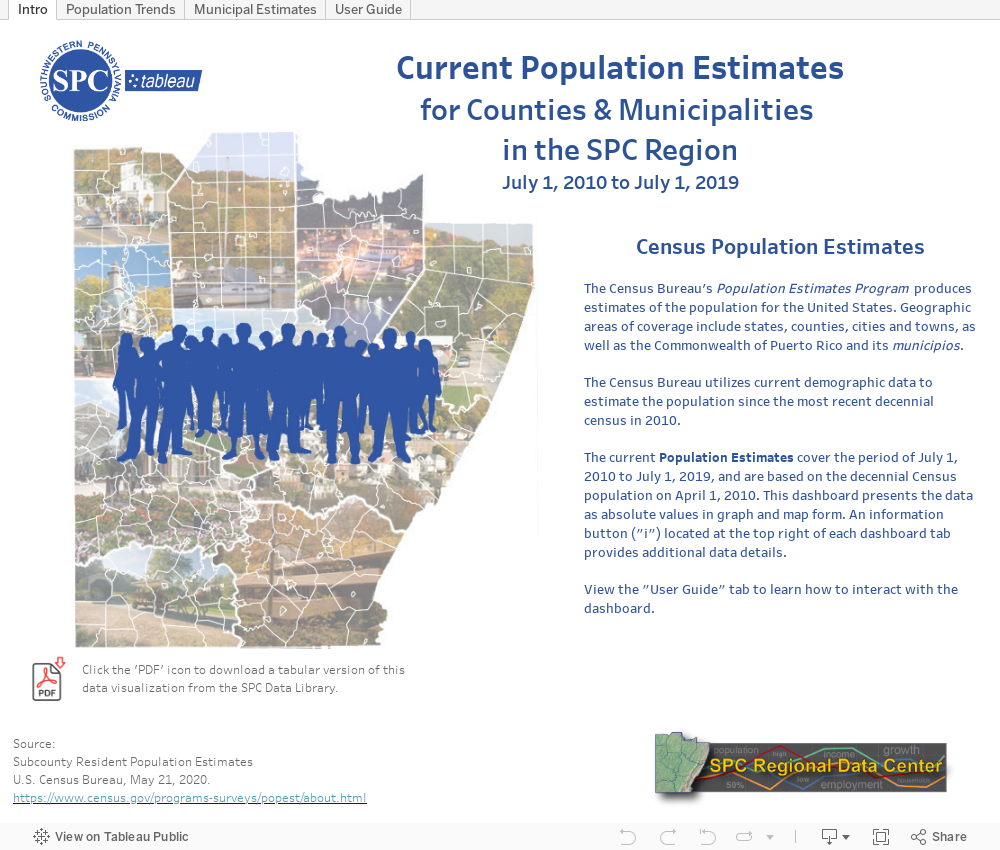
We’ve updated the SPC Regional Data Center “Visualize: SPC Tableau” with the Census Bureau 2010-2019 Total Population Estimates by Municipality in the SPC Region. The dashboard can display a variety of indicators and data comparisons by municipality, county, and region, based on user selections.


SPC holds hearing on funding

Indiana and nine other counties in the greater Pittsburgh region are seeking to figure out how to best spend federal and state funds meant for a wide range of transit and transportation projects.

The newest Transportation Improvement Plan for the region (from Oct. 1, 2020, to Sept. 30, 2024) will include more money for interstate projects and less for local projects.


“It is disappointing that the funding that we all need to advance our projects isn’t there,” said Byron Stauffer Jr., executive director of the Indiana County Office of Planning and Development, during a 48-minute virtual public meeting of the Southwestern Pennsylvania Commission.

What SPC Director of Transportation Planning Andy Waple called “SmartMoves for a Changing Region” is part of what overall is a $22.7 billion plan for the next 25 years, including $5.6 billion over the next four federal fiscal years, which begin in October and end in September.

Read the full article at indianagazette.com


Public Comment: Draft 2021-2024 TIP

SPC wants to know what you
think about transportation projects in the region that will advance over the
next four years.

We are seeking input from the public on the following important
draft documents:

  • Draft 2021-2024 Transportation Improvement Program (TIP), which identifies the region’s priority roadway, transit  and multimodal transportation improvements programmed for advancement over the next four years
  • Environmental Justice Benefits and Burdens Assessment of the Draft 2021-2024  TIP
  • Air Quality Conformity Determination for the Draft 2021-2024 TIP
  • Amendment to the region’s transportation plan SmartMoves for a Changing Region  to reflect updated revenue projections and a revised project list including  project phasing and cost information included in Draft 2021-2024 TIP


Three virtual public meetings will be held that will provide an overview of the draft documents, updates on project advancement, and opportunities for the public to ask questions and submit comments.

Note: Due to the COVID-19 pandemic and Governor Wolf’s Stay-At-Home orders, SPC is unable hold in-person public meetings at this time. Virtual public meetings and other online public participation opportunities will be provided for interested parties to review and comment on draft documents. SPC will provide paper copies of materials upon request.


SPC Announces Vincent Valdes as New Executive Director & President/CEO

SPC Announces Vincent Valdes as New Executive Director & President/CEO

Pittsburgh, PA—The Southwestern Pennsylvania Commission (SPC) Board has selected Vincent Valdes, an engineer and planner, as the new President & CEO of the organization.

“We
are very excited for Vince to begin leading our regional planning and
transportation organization,” said County Executive Rich Fitzgerald, Chair of
the SPC Board. “His experience, enthusiasm, knowledge and background are
exactly what we need as we enter into a new era of transportation and economic
growth for the region.”

The search committee, chaired by Commissioner Larry Maggi, former SPC Chair and Washington County Commissioner, led this process with the help of search firm Krauthamer & Associates. The committee sought a dynamic and innovative leader who could manage a complex planning organization and who would be willing to roll up his or her sleeves to build, inspire and develop a regional plan to support this region’s growth.


“We
are extremely happy with our new choice for SPC. The SPC executive board did an
exhaustive application and interview process and unanimously agreed upon Mr.
Valdes,” said Maggi. “He has demonstrated from his experiences that he is very
capable to handle the current and new challenges that SPC faces. I believe our
organization will be in a good place with Mr. Valdes’ leadership.”

Since
April 2008, Valdes has served as the Associate Administrator for the Office of
Research, Demonstration and Innovation with the Federal Transit Administration
(FTA) of the U.S. Department of Transportation in Washington, D.C. In addition
to serving in previous roles with the FTA, Valdes was a lead planner with the
District of Columbia Office of Planning, and worked for organizations including
Inter-American Foundation, The World Bank, ICF Incorporated, and General
Dynamics, Northrop, and Pratt & Whitney. He holds a master’s degree in
Urban Planning from Columbia University and earned his bachelor’s degree in
aerospace engineering from Boston University.

“I
am immensely delighted to be joining the Southwestern Pennsylvania Commission
at this pivotal moment in the region’s history,” said Valdes. “I look forward
to working with the board and each community to spur economic development
through collaborative planning and innovative investments in infrastructure and
transportation.”

SPC
acts as a cooperative forum for collaboration, planning and public
decision-making. SPC develops public investment plans and programs, ensures
that federal and state transportation requirements are being met and operates
with other local partners with the support and trust of the public.
Additionally, SPC serves as the Local Development District and Economic
Development District for southwestern Pennsylvania. In that role, SPC
establishes and puts forth the regional economic development priorities and
provides a wide range of local government assistance programs and public
services to the region.

The
board voted on Valdes’ hiring at its March 30, 2020 meeting. He is expected to
assume the new position on June 15, 2020.

# # #

The Southwestern Pennsylvania Commission (SPC)
is the region’s forum for collaboration, planning and public decision-making.
As the designated Metropolitan Planning Organization (MPO) for the ten-county
region including the City of Pittsburgh and the counties of Allegheny,
Armstrong, Beaver, Butler, Fayette, Greene, Indiana, Lawrence, Washington, and
Westmoreland, SPC is responsible for planning and prioritizing the use of state
and federal transportation funds allocated to the region. As the Local
Development District (LDD) and Economic Development District for Southwestern
Pennsylvania (as designated by the U.S. Appalachian Regional Commission and the
U.S. Department of Commerce), SPC establishes regional economic development
priorities and provides a wide range of public services to the region.


COVID-19 Working Capital Loan program – UPDATED

COVID-19 Working Capital Loan program

UPDATE – Thank you very much for your interest in the PIDA CWCA Working Capital Loan Program. PIDA has informed SPC that their office has received 890 applications from across the Commonwealth, totaling $75.6 million in requested funds. As you may be aware, PIDA only had $61 million to disburse through the CWCA program. Therefore, PIDA is no longer accepting applications for the program at this time.

In the event that the program is reauthorized, and you have already submitted an application, SPC will continue to process your application at that time.

There are still funding options available through the federal government, and we have provided links to those programs below. We would encourage you to apply for federal funding through the appropriate agencies:

SBA Disaster Loan – https://disasterloan.sba.gov/


Thank you for your interest in the PIDA COVID-19 Working Capital Loan program. Below, please find a PDF of the documents you will need to submit in order to apply for a PIDA COVID 19 Working Capital Loan. There are quite a few documents here, so we advise that you first read the document titled “PIDA COVID-19 Working Capital Loan Application Instructions,” as that lays out, in detail everything you need to submit in order to apply for PIDA’s new loan program.

Once you have compiled and completed all of the necessary information, please attach your application to ONE email, and send it back to me at smeredith@spcregion.org.

As SPC’s staff is in a work from home status right now, please also feel free to email me with any questions that you may have as you work your way through the documents.

Thank you,
SPC Business Finance Staff


2020 Census Day

Today is Census Day!

Now more than ever, it’s important to respond to the #2020Census and help shape the future of your community.

Respond online at  2020CENSUS.GOV

According to the U.S. Census Bureau: The results of the 2020 Census will help determine how hundreds of billions of dollars in federal funding flow into communities every year for the next decade. That funding shapes many different aspects of every community, no matter the size, no matter the location.


Think of your morning commute:
Census results influence highway planning and construction, as well as grants
for buses, subways, and other public transit systems.

Census results affect planning and funding for infrastructure—including programs for highway planning and construction, Section 8 housing, federal transit, community development, and rural water and waste disposal systems.


Encourage
Others to Respond Today

Make sure your employees, customers,
partners, friends, family and social networks know about the importance of
responding to the census. Responding now will minimize the need to send census
takers out into communities to follow up.

  • Download these pledge and challenge images, or create a custom image of your own, and share it with your network and followers.
  • Post and share Census Bureau PSA videos. 
  • Post a 2020 Census web badge on your website directing to 2020census.gov for response.
  • Share this half-page handout with your email lists.

As of today, more than 36 percent of households across the country have already responded to the 2020 Census, but there is more work to do. Check out the Census Bureau’s Response Rates Map to see how your community is doing.

2020 Census Response Rate by Census Tract

Click here to view.

Map is updated each weekday with the latest Census self-response data


SBA EIDL/PPP/PIDA Webinars

SBA EIDL/PPP/PIDA Webinars

Below please find a series links to some helpful webinars that contain information on the various federal and state government programs designed to assist businesses navigating the COVID-19 outbreak.  These webinars are hosted by the Pennsylvania Small Business Development Center, and will be streaming live on YouTube daily, during the week of March 30 through April 3, 2020, from 9 am to 10:15 am.

DATE PAGE URL
March 30              https://youtu.be/JOxhroL9l5M
March 31 https://youtu.be/f-4QucbQrCQ
April 1              https://youtu.be/qOcTgO7tnJs
April 2              https://youtu.be/Hypsfwjq6rY
April 3              https://youtu.be/Oq7qdWfUW50

PASBDC YouTube Main Page


SPC Completes 3rd Cycle of Regional Traffic Signal Program

SPC Completes 3rd Cycle of Regional Traffic Signal Program

Nearly $4 Million in Upgrades to 148 Intersections

Pittsburgh, PA- The Southwestern Pennsylvania
Commission’s (SPC) award-winning Regional Traffic Signal Program is committed
to implementing projects with their federal, state, and local planning partners
that demonstrate innovation, coordination, and measurable results. Since 2008,
this program and its projects embody the implementation of safe and efficient
traffic operations, providing outstanding cost-savings, environmental, and
quality-of-life benefits to the communities and residents throughout the
10-county Southwestern Pennsylvania region. SPC, in cooperation with the
Federal Highway Administration (FHWA), the Pennsylvania Department of
Transportation (PennDOT), its planning partners, and local municipalities
across the region, has completed its third cycle of projects under the Regional
Traffic Signal Program.

Nationwide, these types of signal projects, on average, have yielded $20 to $40 of public benefit for every $1 invested—in part by making the most efficient use of the transportation infrastructure already in place.


Projects completed in the
third cycle of the program are listed below. In addition to traffic signal
retiming, improvements on some of the corridors included new energy efficient
LED signal indications, new communications equipment and new controlling
equipment to facilitate signal coordination. All third cycle projects were
substantially completed in 2019.

Projects completed in the third cycle included major
corridors such as US Route 19 and State Route 228 in the Cranberry area, State
Route 121 (Greentree Road) and US Route 30 in North Huntingdon.

Based on before and after studies conducted by the
program, the annual benefits derived from the completion of the third cycle of
projects include:

  • Reduced vehicle hours of travel:  over 1.3 million
  • Reduced fuel consumption: over 976,000 gallons
  • Reduced total pollutant emissions: over 118 tons (Carbon
    Monoxide, Nitrogen Oxides, and Volatile Organic Compounds)
  • Reduced number of vehicular stops: 18 million

Cumulatively, the third
cycle of projects provided $23 of public benefit for each $1 invested.
During the most congested periods of the day, the average reduction in
vehicular delay across all third cycle projects is 23%.

Municipalities
have also been appreciative of the results of the Regional Traffic Signal
Program. “The SINC-UP project that we did with SPC was a huge success for North
Huntingdon,” said Mike Turley, North Huntingdon Township Assistant Manager.
“With economic growth continuing along the US Route 30 corridor, we need to
make sure that our traffic signals are working efficiently and we are able to
do so with this program. Also, we were able to add an emergency preemption
system with this program that helps to reduce emergency response times.”

With the completion of three cycles of this program, SPC and its partners have invested nearly $11 million to improve 649 signalized intersections across 77 municipalities and every county in our region. Through the first three cycles of this program, results have yielded a $51 of public benefit for every $1 spent in terms of reduced delay, reduced vehicular stops, and reduced fuel consumption and emissions.

Projects Completed in the
Third Cycle of SPC’s Regional Traffic Signal Program
Coordinating Municipalities/Agencies County/Counties Corridors
City of Washington Washington Main Street
North Huntingdon Township/Irwin Borough Westmoreland US Route 30
City of Butler/Butler Township Butler State
Route 356
Slippery Rock Borough Butler Franklin Street/Main St
corridors
Cranberry Township Butler Rochester
Road
Cranberry Twp./Adams Twp./Seven Fields Borough Butler State Route 228/Freedom Road
Cranberry Twp./Marshall Twp. Butler US Route 19
Ellwood City Lawrence Lawrence Ave./Fountain Ave.
corridors
Ambridge Borough Beaver State Route 989/Merchant Street corridors
Brentwood Borough Allegheny Brownsville Road
Green Tree Borough Allegheny Greentree Road
Municipalities of Bethel Park
and Upper St. Clair
Allegheny McMurray
road
City of McKeesport Allegheny State Route 148
City of Pittsburgh Allegheny Liberty Avenue
Midland Borough Beaver State
Route 68

–XXX—

The
Southwestern Pennsylvania Commission (SPC) is the region’s forum for
collaboration, planning and public decision-making. As the designated
Metropolitan Planning Organization (MPO) for the ten-county region including
the City of Pittsburgh and the counties of Allegheny, Armstrong, Beaver,
Butler, Fayette, Greene, Indiana, Lawrence, Washington, and Westmoreland, SPC
is responsible for planning and prioritizing the use of state and federal
transportation funds allocated to the region. As the Local Development District
(LDD) and Economic Development District for Southwestern Pennsylvania (as
designated by the U.S. Appalachian Regional Commission and the U.S. Department
of Commerce), SPC establishes regional economic development priorities and
provides a wide range of public services to the region.


Final Draft TDM Action Plan Released

The Southwestern Pennsylvania Commission (SPC) has developed a regional Transportation Demand Management (TDM) Strategic Action Plan. TDM involves encouraging use of transit, ridesharing, bicycling, walking, telework; shifting travel times; or avoiding unnecessary trips. This planning initiative facilitates collaboration among:

  • The Southwestern Pennsylvania Commission (SPC)
  • Pennsylvania Department of Transportation (PennDOT)
  • Pennsylvania Division Office of the Federal Highway Administration (FHWA)
  • Other TDM stakeholders in Southwestern Pennsylvania to create a regional transportation demand management planning framework


Transportation demand management, or TDM, focuses on the decisions that people and businesses make every day about how they travel. Managing travel demand involves providing travelers with information, options, and incentives that expand travel choices beyond driving alone, such as use of transit, ridesharing, bicycling, walking, and teleworking. For those who drive, it also involves shifting travel to less congested times or routes, or avoiding trips entirely in order to reduce traffic congestion, improve system efficiency, and enhance quality of life.
The plan establishes and prioritizes goals and strategies that build upon existing efforts and programs to improve mobility options by:

  • Maximizing the efficiency of the region’s existing infrastructure.
  • Better integrating TDM initiatives with regional and local transportation planning.
  • Developing focused TDM planning strategies into operations and safety, sustainability as well as economic and community vitality.
  • Enhancing the region’s existing communities by supporting connections to transit, walking and bicycling.
  • Coordinating TDM activities among all of the region’s TDM implementers and stakeholders in order to maximize investment and to deliver consistent, complimentary strategies.

This plan will also support and implement the vision, policies and goals in the region’s Long-Range Transportation Plan, SmartMoves for a Changing Region.

Download the Final Draft TDM Action Plan