An Update on SPC’s Regional Freight Plan (and Why It’s Important!)

By Mason Fish
SPC
10/29/2025

The way goods move across Southwestern Pennsylvania shapes nearly every part of daily life, from how grocery stores stay stocked to how local industries get their products to the market. Behind the scenes, freight networks connect the region’s roads, railways, airports, and waterways into one complex system that keeps the economy running. That constant, mostly unseen movement is one of the reasons our region works, and it is why updating the Regional Freight Plan matters.


The Southwestern Pennsylvania Commission (SPC) adopted its first Regional Freight Plan in 2017. At the time, the plan helped set priorities for maintaining and improving the systems that move goods across the 10-county region that the organization serves. But in the years since, the world has changed dramatically. Supply chains have been reshaped, consumer habits have shifted, shippers have adapted, and the local economy has continued to evolve from where it was a decade ago.

Therefore, SPC is now leading an update to the Regional Freight Plan, in order to make sure the region can keep goods moving efficiently and safely for years to come!

While freight can seem like a technical subject, the core idea behind the plan is simple. Freight is about how things get where they need to go. From raw materials to finished products, the freight network touches nearly every aspect of daily life.

“We like to think of our freight network as a system… a highway system supported by a rail network, supported by rivers, supported by an airport. They all have to work together,” said SPC Freight Planning Manager Sara Walfoort.

When it works well, businesses can grow, communities are supplied, and the region stays economically connected. When it struggles, everyone feels the effects. Southwestern Pennsylvania is unique when it comes to freight movement. The region’s geography, history, and industrial makeup have created a truly multi-modal network. Many places in the U.S. rely almost entirely on trucking, but in our region, the network has always been broader.

The region has:

  • 18 active railroads; approximately 30 percent of the railroads in PA;
  • Over 1,300 miles of rail lines within the 10 counties SPC serves;
  • One of the busiest inland river ports in the country, historically ranking among the top nationally when measured by tonnage;
  • A highway system that connects to major population centers and industrial corridors; and
  • Air cargo capacity that supports high-value, time-sensitive products.

This diversity matters, and different modes of transportation serve different needs. Heavy commodities like coal, steel inputs, or construction aggregates can move efficiently by river barge. High-value or urgent products, such as medical components or electronics, may move by air. Trucks are essential for reaching the thousands of communities that rail and river terminals don’t directly serve. Rail is critical for long-haul shipments and energy supply. When all of these systems work together, companies have options which allows the region to maintain a competitive advantage.

However, this system only works if it is maintained, modernized, and coordinated. A closed lock on a river, for example, can shift freight onto trucks, sending thousands of additional heavy vehicles onto roadways. Congestion on a key highway can slow deliveries. Rail bottlenecks can hold up shipments across multiple states. And when one part of the network becomes strained, the whole system feels the impact.

That is where the updated Regional Freight Plan comes in. This document will take a clear look at how goods actually move through our region today, mapping out the roads, railways, river facilities, and other key connections that form the backbone of the network. It will highlight where strategic investments could improve safety and reliability, while also supporting more efficient movement of goods.

While SPC is not a freight operator and doesn’t run trains, barges, or fleets of trucks, it does play a central role in planning, investment prioritization, and coordination. The updated plan will serve as a bridge between public agencies, private industry, and the broader community, ensuring that decisions are made with a clear understanding of how the freight network works and what the region needs next.

“I want to move to a more systems-based approach, looking at roadway condition, track history, bottlenecks, and how trucks traverse roads… so we can invest freight improvement dollars wisely,” said Walfoort.

The updated plan is expected to be delivered by June 2027, with a focus on making targeted improvements across the region’s transportation network. 

The hope for this new blueprint is to help SPC prioritize investments that strengthen the network as a whole rather than addressing issues in isolation. The plan will assess things such as essential corridors and facilities to identify constraints, reduce delivery delays, improve safety, and help businesses get products to market more efficiently. Better coordination among freight modes could lower transportation costs, support economic growth, and ensure the region remains competitive.

The update also aligns closely with SPC’s Long Range plan and with the Pennsylvania 2045 Freight Movement Plan adopted at the state level. By keeping these plans synced, SPC helps ensure that regional priorities are recognized and funded at the state and national levels.

To make the updated freight plan meaningful, SPC is focusing not only on data and infrastructure, but also on communication and public understanding. Many people fail to realize how closely freight is tied to economic opportunity, community stability, and quality of life. This newsletter is one part of that effort in helping connect the dots between freight movement and daily life.

At the end of the day, it’s about supporting the future of the region’s economy, from job creation to infrastructure investment to keeping everyday goods moving where they’re needed. Freight touches everything, even if most of the work happens out of sight.

As the update progresses, SPC will share opportunities to learn more and participate. Whether you work in logistics, manufacturing, retail, healthcare, or just shop for groceries, the freight network helps ensure products reach homes, businesses, and communities across the region.
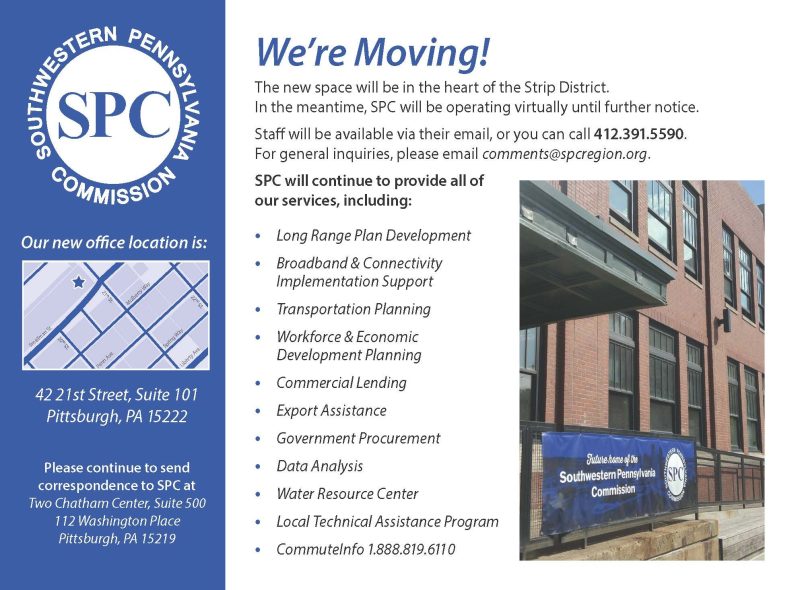


SPC is Moving!

We’re Moving!

The new space will be in the heart of the Strip District. In the meantime, SPC will be operating virtually until further notice.

Staff will be available via their email, or you can call 412.391.5590. For general inquiries, please email comments@spcregion.org.


SPC will continue to provide all of our services, including:

  • Long Range Plan Development
  • Broadband & Connectivity Implementation Support
  • Transportation Planning
  • Workforce & Economic Development Planning
  • Commercial Lending
  • Export Assistance
  • Government Procurement
  • Data Analysis
  • Water Resource Center
  • Local Technical Assistance Program
  • CommuteInfo 1.888.819.6110

Our new office location is: 42 21st Street, Suite 101, Pittsburgh, PA 15222

Please continue to send correspondence to SPC at Two Chatham Center, Suite 500 112 Washington Place, Pittsburgh, PA 15219

A graphic announces SPC's move to the Strip District


Holiday Greetings from SPC Executive Director Vincent Valdes

To our valued Members, Planning Partners and Colleagues:

As this year draws to an end, I must begin with a heartfelt thank you to our Members, whose communities comprise the region we at SPC are honored to serve. It is your unwavering support that enables and inspires us to do our best work every day, work that ultimately improves the quality of life for our region’s residents.

Thank you to our Planning Partners, without whose contributions our work would be impossible. It is your intimate knowledge of the needs of your communities and programs that informs and guides our commitment to keep southwestern Pennsylvania connected and moving forward.


Thank you to our Colleagues and the communities and residents of southwestern Pennsylvania. This region is your home, and we’re planning to keep it a great place to live. Each day in our work, we strive to advance our regional vision of a world-class, safe, well maintained and connected multimodal transportation system that provides mobility for all, empowers resilient and sustainable communities, and supports a globally competitive economy.

I would also like to take a moment to thank the SPC staff for their tireless work. Without their dedication and their collaboration with our Members, Planning Partners and Colleagues, the region would not have secured $24.8 in Build Back Better funds, completed the Broadband Connectivity Implementation Program (CIP), won the APA’s prestigious Award for a Plan for SmartMoves Connections, or adopted the 2023-2026 Transportation Improvement Program (TIP).

We look forward to 2023 with great anticipation as we will be moving into our new offices in the Strip District early in the year, leading the Regional Broadband Summit in February, planning the Expanding Career Pathways Summit and developing the long range plan update for adoption in June.

Thank you for being with us in 2022 and we look forward to even more success next year in 2023! May you and your families have a safe, healthy, and very happy holiday.

Regards,

Vincent Valdes


Statement from Vincent Valdes on the passing of Richard Hadley

It was another sad day in Southwestern Pennsylvania with the passing of Cranberry Supervisor and SPC Commissioner Richard Hadley,” said Vincent Valdes, SPC Executive Director. Commissioner Hadley represented Butler County on the Commission since 2015. He was dedicated to real-world planning and championed mixed use and complete streets policies for Cranberry Township as a long-time township supervisor. He brought his passion for planning to SPC’s regional forum and we will miss his expertise on how to plan for growing communities. Every day, the residents of Cranberry Township are witness to and of his life-long, dedicated public service.

Vincent Valdes

https://www.butlereagle.com/20220825/longtime-cranberry-supervisor-chairman-dies-2/


Statement from SPC Executive Director Vincent Valdes on the Passing of Joe Grata

“It is a sad day for Southwestern Pennsylvania with the passing of Joe Grata. Joe was a lifelong public servant and advocate for our region’s transportation system first as a longtime transportation reporter who shared his deep understanding of the planning, engineering and funding of infrastructure with the public. Later, in his retirement, he worked to advance connectivity, safety and regionalism as an SPC Commissioner representing Fayette County. Joe recognized that all transportation is ‘local’ in the minds of our communities and further understood the role of mobility to regional economic vitality and quality of life. The Commissioners and staff of SPC will miss his perspective, intellect, and sense of humor as we continue our work to keep Southwestern Pennsylvania connected and moving forward.”

Vincent Valdes


Obituary: P. Joseph ‘Joe’ Grata | Post-Gazette, Press reporter and civic leader | Pittsburgh Post-Gazette


How Bridge Financing Can Help Small Businesses

Author: Steve Meredith, Manager, Business Finance.

On several occasions throughout the year, I will have a
promising opportunity come across my desk, only to fall apart because the
timeline for my organization’s economic development loans does not fit with
what the client needs. While I can certainly understand the need to be flexible
and work with clients, their sellers, and other financial institutions, there
are a few aspects of economic development lending that can delay closing on
publicly funded loans. This results in a tricky “dance,” in which
economic development lenders, their borrowers, sellers, and often private
lending institutions must participate to ensure the best interest rates and
terms for small business clients.


Economic development lenders generally do not have loan review committee meetings as often as private banks. This means that there will likely be some lag time between when you submit your loan application, and when the loan is presented for review and approval. In the interim, economic development lenders will be reviewing your application, performing underwriting, and asking questions about your business in order to add clarifying information to your loan package for their respective loan review committees.

Even after your loan is reviewed and approved by the
appropriate committee(s), your economic development lender may not have
in-house counsel on call, meaning that they need to send your loan package out
to a third-party law firm to draw up the closing documents. This can take time
since the firm drafting the closing documents likely has many other clients to
handle.

In addition to drawing up the closing documents, your
economic development lender may have additional requirements, such as the
assignment of a key person life insurance policy, which will need to be taken
care of before closing. Small business owners will want to pay attention to any
communication from their economic development lenders following their loan’s
approval. Your lender may ask for additional information from you after the
loan is approved, but before the closing documents are signed.

As I mentioned at the beginning of this article, the issue
of buyers’ and sellers’ timelines not matching that of my organization is a
common occurrence and fortunately, there is a work-around for those
entrepreneurs who may be experiencing exponential growth in a short period. In
your initial conversation with your economic development lender, ask if it is
possible to partner with a private lender, and for that private lender to
“bridge” the economic development lender’s portion of the project
proceeds. Chances are that most economic development lenders already have a
leveraged private capital requirement, and they will have likely made loans in
the past that have featured this type of financing.

When a private lender bridges an economic development
lender’s portion of the project proceeds, the borrower receives 100% of the
proceeds when they close on the private lender’s loan. Then, whenever the
economic development lender completes their loan approval and closure
processes, the borrower takes the proceeds from the economic development loan
and pays off the bridged portion of proceeds from the private lender. This
results in a more desirable two loan structure, featuring a private lender, and
an economic development lender that disburses public funds at a low-interest
rate.

Economic development lenders exist to offer low-cost
financing to small businesses looking to fund startup or expansion costs. At
the end of the day, it is in everyone’s best interest to work together and try
to close economic development loans following a timeline that both buyers and
sellers deem acceptable. That being said, when you are dealing with economic
development lenders who provide publicly funded loans, it is important to
understand that additional due diligence is often required by the government before
the disbursement of taxpayer-backed funds. This additional due diligence is
meant to ensure that public funds are used in a manner that is going to
strengthen the economic prosperity of a given county or region, which is in the
best interest of the small business owner, and their customers.

The Southwestern Pennsylvania Commission provides government-backed financing for small business start-ups and expansion activities. If your business is located in the Southwestern Pennsylvania region, and you’d like to learn more about how you can apply for financing through the Southwestern Pennsylvania Commission, please feel free to reach out to me via email at smeredith@spcregion.org. I’d be happy to help you out!

Visit the SPC Business Assistance page to learn more!