SPC applies for Middle Mile Broadband Infrastructure Grant Program

The Southwestern Pennsylvania Commission (SPC), in partnership with DQE Communications, is applying to the Middle Mile Broadband Infrastructure Grant Program (MMGP) to establish and enhance fiber-based infrastructure across the 10-county southwestern Pennsylvania region. SPC is the federally-designated metropolitan planning organization (MPO) responsible for the region’s transportation planning process, as well as the Local Development District and Economic Development District, that establishes regional economic development priorities and provides a wide range of technical services to the region.

In 2022, SPC developed A Connectivity Roadmap for Southwestern Pennsylvania, a strategic regional plan to identify and guide the deployment of high-speed connectivity programs and projects throughout southwestern Pennsylvania. The Connectivity Roadmap provides a guide to building a more comprehensive and equitable broadband network that will help connect people to opportunities, jobs, and education; attract new and retain current businesses; and ultimately enable southwestern Pennsylvania to be better- positioned in securing future connectivity funding for potential projects and programs.

The regional cooperation required to develop the Connectivity Roadmap has provided SPC with the tools and information needed to apply to the highly-competitive MMGP, administered by the National Telecommunications and Information Administration (NTIA). Internet fiber-optic networks, also called “middle-mile” networks, act as a superhighway that allows internet traffic to quickly travel across far distances. The exits on the highway are local networks that consumers interact with, like home WiFi or business Internet—these are what we call “last-mile” services and are often offered by other Internet Service Providers (ISP’s). The MMGP focuses on the highway, not the driveway!

Historically, middle mile fiber networks are built, owned, and operated by ISP’s, telecom companies, and electric utility entities who then lease fiber to last-mile providers/ISPs. Therefore, while middle-mile construction does not immediately impact consumer concerns associated with last-mile services, such as plan pricing, speeds, or a pesky router, without extensive middle-mile network enhancements, it becomes difficult and costly to improve current network capacity or to establish reliable networks in underserved and unserved communities. That’s why SPC saw the Middle Mile Grant Program (MMGP) as the natural next step for improving high-speed broadband in Southwest PA.
Learn More!


SPC Releases Crash Responder Safety Week PSA Series

November 14 – 18 , 2022 is Crash Responder Safety Week (CRSW). A Federal Highway Administration (FHWA) sponsored initiative, CRSW communicates the simple steps everyone can take in keeping our roadway responders and the public safe around traffic incidents.

SPC has developed a series of animated PSAs to raise awareness and keep our emergency responders safe on the job.

A new PSA will be released every day of Crash Responder Safety Week. Be “In the know, on the go” by clicking below:

(via https://ops.fhwa.dot.gov)

Every minute of every day, law enforcement, fire and rescue, emergency medical services, public works, transportation, towing, and other responders work roadside to make roadways safe for all road users. Unfortunately, these traffic incident responders put their lives at risk when clearing each of the nearly 7-million annual motor vehicle crashes or the broader range of incidents such as stalled vehicles or roadway debris. CRSW is an opportunity to promote road user awareness and adherence to Move Over laws and Traffic Incident Management (TIM) training for all traffic incident responders.

Visit our Operations and Safety page to learn more!


SPC is Moving!

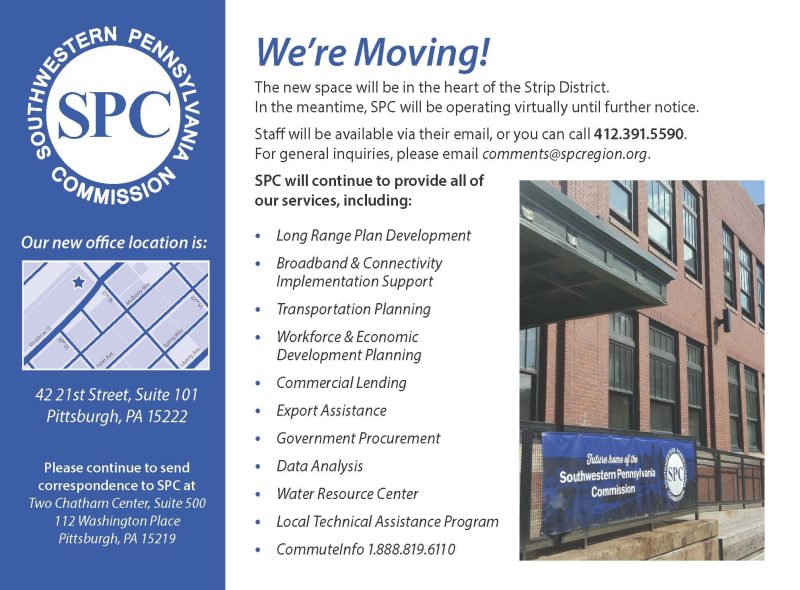
We’re Moving!

The new space will be in the heart of the Strip District. In the meantime, SPC will be operating virtually until further notice.

Staff will be available via their email, or you can call 412.391.5590. For general inquiries, please email comments@spcregion.org.


SPC will continue to provide all of our services, including:

  • Long Range Plan Development
  • Broadband & Connectivity Implementation Support
  • Transportation Planning
  • Workforce & Economic Development Planning
  • Commercial Lending
  • Export Assistance
  • Government Procurement
  • Data Analysis
  • Water Resource Center
  • Local Technical Assistance Program
  • CommuteInfo 1.888.819.6110

Our new office location is: 42 21st Street, Suite 101, Pittsburgh, PA 15222

Please continue to send correspondence to SPC at Two Chatham Center, Suite 500 112 Washington Place, Pittsburgh, PA 15219

A graphic announces SPC's move to the Strip District


Cranberry summit provides update on broadband efforts

“The lack of access to high-speed broadband is a genuine problem in many communities throughout our region,” Southwestern Pennsylvania Commission Vice Chairman and Armstrong County Commissioner Pat Fabian during a Regional Broadband & Connectivity Summit Thursday in Butler County.

SPC is a municipal planning organization representing Pittsburgh and the 10 counties surrounding the city, which seeks to work as one on the goals of transportation, planning and development, and information systems in the southwestern corner of the state.


“Without this, our region’s businesses, households and public institutions cannot prosper,” Fabian said to an audience gathered in Cranberry Township. “At SPC, we believe that by working together with private and public partners and across local, regional, state and federal levels, we can lead the effort to make our vision of affordable, equitable broadband access a reality in every part of southwestern Pennsylvania.”

During the summit, it was reported that most of the 10-county region are either underserved, with download speeds of less than 50 megabits per second (Mbps), or unserved, with download speeds of less than 25 Mbps.

SPC said download speeds between 50 and 99 Mbps are more common in Allegheny and Butler counties, but are found only in small areas throughout the remaining eight counties, including Armstrong and Indiana.

A series of panel discussions took up much of the day, including one regarding the “Pennsylvania Statewide Implementation Plan” and a summary of regional efforts, with Indiana County Office of Planning & Development Executive Director Byron G. Stauffer Jr. as the moderator.

Stauffer has been at the forefront of efforts to expand broadband in Indiana County, with one $2.3 million contract awarded so far and more to be brought soon to the county commissioners. The ICOPD director said the next phase of what eventually will be a $7 million network of broadband connections could be announced as soon as the next meeting of the county board on Wednesday.

Stauffer was joined by two representatives of state agencies, Brandon Carson, executive director of the Department of Community and Economic Development’s Pennsylvania Broadband Development Authority, and Dr. Kyle Kopko, executive director of the General Assembly’s Center for Rural Pennsylvania.

Kopko said there are 19 counties regarded as urban, 48 as rural, with some rural areas in every county except Philadelphia and Delaware counties.

He said there has been stagnation in rural communities in Pennsylvania, with the population in those communities rising from 3.39 million to 2000 to 3.47 million in 2010, then dropping back to 3.38 million in 2020.

Read the full article at IndianaGazette.com


Pittsburgh Post-Gazette: Editorial: Expediting the Charles Anderson Bridge project: An infrastructure win for the Gainey administration

The fate of the Charles Anderson Bridge in Oakland was shaping up to be another embarrassment for the struggling Gainey administration — but Mr. Gainey’s apparent deal with state and federal agencies to accelerate a full rehabilitation of the span, if it is seen through, may turn out to be a welcome example of effective leadership from Grant Street. The bridge carries the Boulevard of the Allies over Panther Hollow.

PennDOT rebuilt the Fern Hollow Bridge in under a year due to the city’s emergency declaration, which allowed design and construction to proceed in parallel. Because the Charles Anderson has been on the decrepit list for so long, much of the preparatory work is already complete. By moving funding up the Southwestern Pennsylvania Commission’s priority list, at least a year may be cut off the construction schedule. This means the city is canceling its remedial repairs and will keep the bridge closed for the duration of the full rehab.


In the morbid discussion of city-owned bridges with inspection results similar to, or even worse than, the collapsed Fern Hollow Bridge, the Charles Anderson Bridge was always near the top of the list. Pittsburghers’ fears were confirmed when the city closed the bridge on an emergency basis on Feb. 1.

Mr. Gainey attempted to dodge responsibility for a postponement of rehab funding for the span. Mayor Bill Peduto’s 2022 capital budget projected $3 million in spending on the Charles Anderson in 2023, but Mr. Gainey’s 2023 capital budget pushed that projection back an entire year. The mayor attributed this to a postponement by the SPC transportation planning agency — but he sits on the executive committee of the commission. A Post-Gazette investigation later revealed that Mr. Gainey has an extremely poor attendance record at SPC meetings.

Mr. Gainey pleaded that Mr. Peduto’s $3 million plans for the bridge were merely a “projection” and not an “allocation,” but this is wordplay: The fact remains that the plans were delayed on his watch.

Securing a deal to expedite the bridge’s reconstruction, however, would reverse this mistake and maybe build some positive momentum for the floundering administration.

There are still unanswered questions about just how expedited the process will be. At the meeting where City Council approved the preliminary funding, Department of Mobility and Infrastructure director Kim Lucas would only commit to “before 2027” for a completion date. Since 2027 was when construction was supposed to happen under the original 2022 SPC plan, with bids going out mid-2025, Pittsburghers who use this vital connection are right to want a more specific commitment.

Further, early statements from the city misstated the nature of its own agreement with state and federal agencies, another sign of amateurism in the mayor’s office.

But let’s dwell on the positive: Mr. Gainey’s office effectively advocated for city infrastructure in the labyrinthine state and federal funding process. It’s a success we need to see the mayor repeat many times in the years to come.

Read the full article at post-gazette.com.


East Franklin Township offers update on efforts to make SR 422/Glade Run Road intersection safer

It certainly would be no mere play on words to say one particular matter in East Franklin Township hits close to home for Larry Richardson.

An ongoing sense of urgency expressed by many to make safer the State Route 422/Glade Run Road intersection in the municipality is understood and appreciated more than most by people such as Richardson, the municipality’s zoning officer, who resides not far from the junction that counts at least one traffic-related fatality in recent years.


“I use it at least once or twice a day,” said Richardson during Thursday’s monthly public meeting of East Franklin Township’s board of supervisors.

It was with that in mind that Richardson, acting in place of township Supervisor David Stewart at the meeting until he arrived, delivered the latest update on efforts largely spearheaded by 16-year-old Gracie Elosser to pursue safety enhancements at the intersection.

Since a deadly accident on July 3, 2021, at the site that led to the death of Kenneth Robert Shaffer, 60, who was killed in a motorcycle accident after hitting a truck there, Elosser has been routinely attending township meetings and offering her opinion that the intersection is a danger to drivers.

With Elosser once again present at the board’s most recent meeting proceeding, Richardson detailed plans by Pennsylvania Dept. of Transportation (PennDOT) District 10 to move forward with related efforts to make passing through the junction less of a risk for motorists.

“At the present time, there is a project out to correct the pavement and do painting on the pavement (at the intersection),” he said.

The state agency intends to apply painted traffic warnings known as optical speed bars, which would be designed to more efficiently catch the eyes of motorists in an effort to make them aware of the need to curtail their speed as they approach the intersection, he said.

“The lines (would) start about 1,000 feet out, go the whole way across the highway and they increase in volume as you get near the intersection,” Richardson said. “So the closer you get to the intersection, the faster you look like you’re going, and hopefully, they say, that will slow people down.”

PennDOT also intends to place a device known as a speed minder, which would rest on a portable trailer near the intersection, for every four to six weeks starting in April, he said.

“They’re going to put it there for four to five days at a time, either Monday through Friday or Friday through Monday,” Richardson said. “They hope to do that starting in April for five to six months, which would take them in to September. So it’s during the spring and summer.”

In addition, a plan is in play to rectify the positioning of stop signs at the intersection.

“There are two stop signs, and they are either coming from the Fox Hollow side or the Glade Run side on the north side, one you come up on it straight ahead, and one’s to the right,” Richardson said.

PennDOT also told Richardson a work order is in the works to better position stop signs directing traffic at the site.

“Hopefully that’ll all start soon,” he said.

Referencing a road safety audit conducted on the intersection by the Southwestern Pennsylvania Commission (SPC), Richardson said one of the options PennDOT also would be to allow traffic flow at the site only to motorists turning right.

“They’d put a concrete barrier down the medial strip so you can’t go straight across and you can’t make a left-hand turn,” he said.

PennDOT has also requested that Pennsylvania State Police (PSP) trooper from Troop D, Kittanning, be assigned to sit at the site and evaluate speed via radar. Another option, according to Richardson, would be for PennDOT to install high-resistance pavement to help motorists quickly stopping their vehicles maintain control.

When given the chance to ask questions, Elosser questioned when all the aforementioned work would commence, to which the answers remained vague. “I was told today there are many, many more intersections in the state of Pennsylvania that are more dangerous than that one,” Richardson said.

View the full article at leadertimes.com


SPC releases new Request For Proposals and Request For Qualifications

CommuteInfo Vanpool Vehicle and Fleet Support Services RFP

The Southwestern Pennsylvania Corporation, a 501(c)(3) corporation, on behalf of the Southwestern Pennsylvania Commission (SPC), is requesting Technical Proposals and Price Proposals (together, Proposal packages) for CommuteInfo Vanpool Vehicle and Fleet Support Services. The selected firm or team of firms will provide SPC with the following support services for its CommuteInfo Vanpool Program: vanpool vehicles; fleet maintenance/management; driver support, contracting, and invoicing services; fleet insurance; and data collection.


The Request for Proposals (RFP) was released by SPC on April 19, 2023. Copies may be downloaded from the SPC Website (www.spcregion.org) or may be obtained by e-mail request to Anthony Hickton at Ahickton@spcregion.org.

Electronic submissions will be required via SPC’s SharePoint site. Full submission details are provided in the RFP document. Proposal packages are due on May 19, 2023.

RFP Document Download Request Form


On-Call Consultancy Services RFQ

The Southwestern Pennsylvania Corporation, a 501(c)(3) corporation, on behalf of the Southwestern Pennsylvania Commission (SPC), is requesting Statements of Qualifications and Pricing Details Compilations (together, Statement of Qualifications packages) for On-Call Consultancy Services. SPC is seeking to engage up to five full-service teams of firms to provide “on-call” delivery of a wide range of specialized support services as the need arises related to SPC’s functional areas of Transportation Planning, Strategic Initiatives & Policy, Economic & Workforce Development, Information & Data, Finance, Public Relations & Communication Initiatives, and Human Resources. 

The Request for Qualifications (RFQ) was released by SPC on April 19, 2023. Copies may be downloaded from the SPC Website (www.spcregion.org) or may be obtained by e-mail request to Kristin Baum at kbaum@spcregion.org.

Electronic submissions will be required via SPC’s SharePoint site. Full submission details are provided in the RFQ document. Statement of Qualifications packages are due on May 24, 2023.

RFQ Document Download Request Form


Pittsburgh Post-Gazette: New design for Oakland’s Charles Anderson Memorial Bridge unveiled

Construction on Pittsburgh’s Charles Anderson Memorial Bridge project could begin as early as spring 2024, city officials said Monday.

The most recent project update indicates the design phase for the bridge should be completed by the end of this year. Construction is “anticipated to begin” next spring and is expected to take two construction seasons.

The bridge was closed in early February, after inspections showed the need for immediate repairs to the 85-year old steel deck truss bridge. The bridge carries the four-lane Boulevard of the Allies over a pedestrian trail and connects Central Oakland and South Oakland with Schenley Park.


The project predicts the removal of one inbound lane on the bridge to accommodate a bicycle lane. There would still be two outbound lanes of traffic with sidewalks on each side.

The scope of the project has also expanded from its initial plan to include the rehabilitation of the Panther Hollow Overpass, which sits just a few hundred yards from the bridge, next to the Schenley Pool.

The bridge crosses over the pedestrian trail and would still be safe for vehicles but would require a weight limit if not updated, officials said.

Combining both bridge repairs into one project means the road would only have to be closed once, Kim Lucas, the director of the Department of Mobility and Infrastructure recently told City Council.

After disputes over the funding, City Council approved a $3.1 million contract for the bridge project, which officials said could accelerate the construction timeline to begin at the end of March.

The city’s 2022 capital budget showed $6 million listed for repairs to the bridge, but that was not included in Mayor Ed Gainey’s budget. Mr. Gainey said that the $6 million was a “projection not an allocation” from former Mayor Bill Peduto’s budget.

Mr. Gainey also said funding for infrastructure projects in the region funnels through the Southwestern Pennsylvania Commission, of which he sits on the executive committee.

The city’s Department of Mobility and Infrastructure submitted requests to the SPC and the Pennsylvania Department of Transportation to delay other projects so that the Charles Anderson Memorial Bridge project could receive funding sooner.

View the full article at postgazette.com


WDIY-FM: LVPC Awarded $1 Million Grant to Develop Climate Action Plan, Fight Climate Change

Up to a million dollars in federal funding will be coming to the Lehigh Valley to help develop a plan to fight climate change.

The Pennsylvania Department of Environmental Protection recently announced the grant awards, which are part of the federal Climate Pollution Reduction Grants program.

The Lehigh Valley Planning Commission, along with the Delaware Valley Regional Planning Commission and the Southwestern Pennsylvania Commission, will each receive grants of up to $1 million to help develop climate action plans.


DEP Acting Secretary Rich Negrin called climate change an “existential threat” to safety, security and quality of life in Pennsylvania, and he said tackling the issue must involve cooperation from all levels of government.

“All climate change is local,” Negrin said, “and it’s here right now. It’s here today.”

Negrin spoke about the ongoing impacts of the climate crisis, from flooding and tornadoes to wildfires, which he said have been exacerbated by recent chemical releases and spills. He said the crisis will disproportionately affect the state’s most vulnerable populations first, and that these events are costly.

“According to the National Oceanic and Atmospheric Administration, extreme weather and climate disasters cost the United States approximately $1.65 billion just last year,” he explained.

To take a step in tackling the crisis, Negrin said the state recently opted into the Climate Pollution Reduction Grants program, which is administered by the Environmental Protection Agency.

He said Pennsylvania is posed to receive $3 million, made available through the federal Inflation Reduction Act.

Negrin noted that the three planning organizations also applied to the program, adding up to $3 million more on top of the state’s money. And, he said the program makes state and local entities eligible for other grants from a major funding pool.

“Through this investment, and this is a significant part, Pennsylvania will be creating a priority climate action plan that will make us eligible to apply for a pool of approximately $4.6 billion in funding that is meant to implement projects and activities that we will outline in the priority climate action plan,” Negin said.

“I’m going to say that again, because I don’t get to say that number so often, $4.6 billion that can be utilized and brought back here to Pennsylvania to develop and fight climate change.”

Becky Bradley, Executive Director of the Lehigh Valley Planning Commission, said the LVPC has been working for over 60 years to improve air quality, mitigate hazards associated with weather events, and plan for “optimal environmental management and protection.”

“Due to the prioritization of air, water, and land protection by our counties, Lehigh and Northampton, the state and now our federal partners, these new opportunities that have presented themselves are going to help us advance some of the critical things that we need to do,” Bradley said.

She said the planning commission has been conducting public opinion polls for decades, many of which are returning the same feedback.

“And literally for the past 40 years, all of those public opinion polls have prioritized the environment as well as jobs and the economy in the Lehigh Valley.”

Bradley said the Valley has the fastest growing manufacturing economy in the United States, adding more than 22 million square feet of industrial space in less than six years.

However, she said the effects of this booming industrial economy must be balanced with the “public directive” to protect air, water, and land.

“That means our 16 watersheds, that means our vulnerable populations, and this provides us a new opportunity to do that,” she said.

Bradley said the additional federal funding will allow for the creation of new stormwater management ordinances for all 62 municipalities in the Lehigh Valley, providing a regionwide green infrastructure program.

The money will also be used to support regional electric and alternative fuel strategies, smart transportation corridors, permanent air quality monitors, improving walking, biking, and ADA accessibility, and increased investment in LANTA – the local transit authority – to deploy a bus rapid transit system.

Bradley concluded by thanking federal agencies and officials, “for supporting this effort and allowing our region in the Lehigh Valley to actually achieve some of the things that we could only have dreamed of, and balance again jobs, the economy, and the environment for everyone.”

Read the full story at wdiy.org


The Daily Courier: Fayette spotlighted during Southwestern Pennsylvania Commission meeting

Fayette County Commissioner Vincent Vicites put the county on display Monday by hosting the Southwestern Pennsylvania Commission meeting at the Fay-Penn Economic Development Council office.

Vicites serves as SPC secretary-treasurer.

The organization has moved recent meetings while its Pittsburgh Strip District offices are undergoing renovations.


“This is the first time in history that a meeting has been held here with public parties,” Vicites said.

He said officials from Butler, Armstrong, Washington, Allegheny and Greene counties attended the session.

More than 40 people attended the 75-minute session, including several members via internet.

The Fay-Penn site in Lemont Furnace provided video technical applications.

Joseph Ambrose of Republic Food Enterprises said his company’s affiliations with farms of all sizes creates second-source revenue for value-added products in southwestern Pennsylvania and parts of West Virginia and Maryland.

Ambrose catered the event.

Laura Kurtz Kuhns, Fay-Penn executive director, discussed such Fayette County attractions as the Joseph Hardy Connellsville Airport, Fort Necessity and Fallingwater.

She said Fallingwater has been named among the nation’s most loved attractions. The house near Mill Run was designed by architect Frank Lloyd Wright and is considered to be his residential masterpiece.

Dom D’Andrea, director of transportation planning for the region’s long-range plan, outlined topics discussed in recent weeks during Fayette County commissioners’ meetings.

He said the planning sequence that runs through 2025 is reviewed every four years.

SPC members unanimously endorsed highway bridge investments, new transit investments and air quality conformity determination.

Major attention through investments will be given to Interstate highways 79, 70 and 376. In the long term, roughly $2.2 billion is expected for highway improvements.

A Vision Zero Plan will be implemented for Allegheny County, with a goal of achieving zero deaths or serious injuries from motor vehicle accidents.

Allegheny County has had more than half of the serious accidents in Southwestern Pennsylvania.

A Competitive Economy Infrastructure and Technology for Sustainable and Resilient Communities program is expected to focus on workforce assistance in areas of need.

View the full article at dailycourier.com