SPC to Host Virtual Small-Business Discussion Forum: “Building Economic Resiliency”

SPC is hosting a virtual Small Business Discussion and Forum on March 16th 2021 at 1:00pm. We want to hear from Southwestern PA businesses.

Soon we will mark one year since the onset of the COVID-19 pandemic. Here at Southwestern Pennsylvania Commission (SPC), we wanted to take this opportunity to hear from our region’s small business owners and find out where your business stands, one year after COVID. We and other regional entities want to hear your feedback on current needs and expected future needs.

This event and your feedback will help SPC determine the types of business assistance programs needed moving forward.

Please visit https://spcsmallbusiness2021.eventbrite.com/ and Register.

We hope to see you on March 16, 2021 at 1:00pm.


We are also gathering information in advance for this meeting from our regional businesses via a brief Survey.


Visualize: SPC Tableau – Data Comparisons in the SPC Region

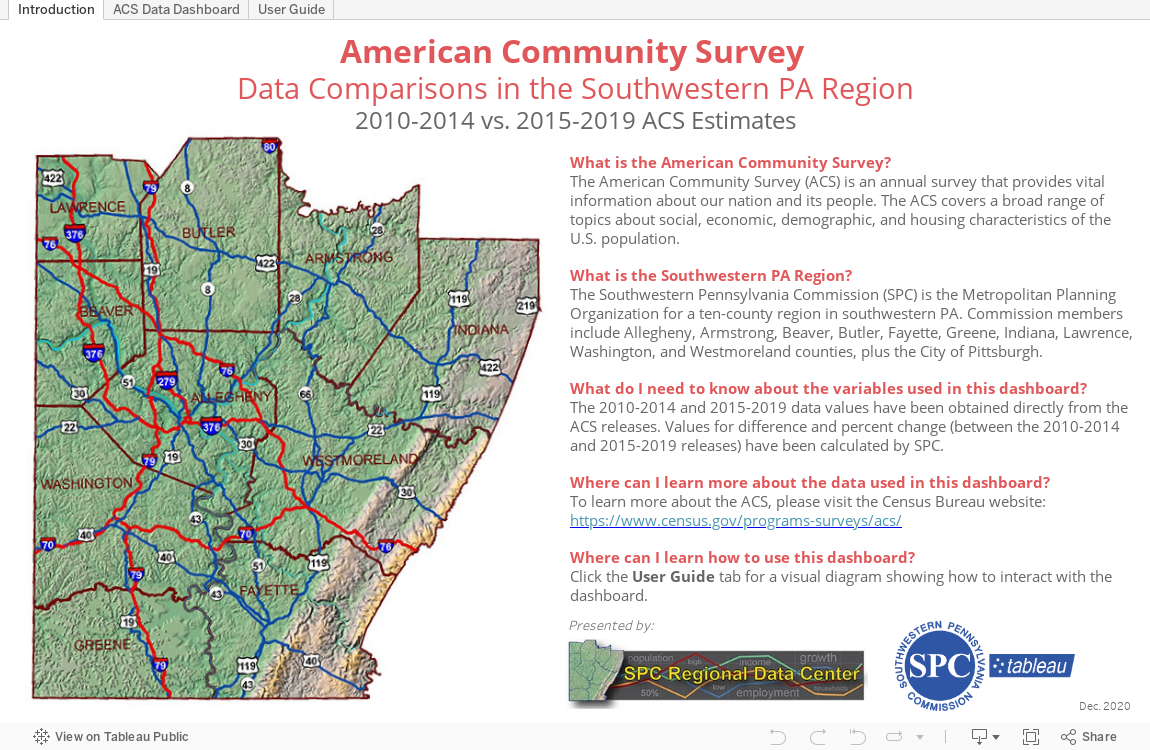
We’ve updated the SPC Regional Data Center “Visualize: SPC Tableau” with the recently-released American Community Survey Data. The dashboard can display a variety of indicators and data comparisons by municipality, county, and region, based on user selections.


Improvement Concepts Identified For Route 28 Corridor

The Southwestern Pennsylvania
Commission (SPC), in partnership with regional partner, today announced the
completion of the Route 28 Corridor Study, outlining forty multimodal
improvements between Kittanning and Interstate 80 (I-80). 

SPC, in partnership with the Northwest Pennsylvania Commission; North Central Pennsylvania Regional Planning and Development Commission; Armstrong, Clarion and Jefferson Counties; the Pennsylvania Department of Transportation, Engineering District 10-0 and its consultant team, recently concluded the study of the approximately 40-mile corridor with the release of the study’s Final Report.


The study of the
approximately 40-mile corridor was initiated in December 2019.  The purpose of the study was to explore
transportation improvement concepts that could be implemented to achieve local
and regional goals. To do so, the consultant team worked closely with the
study’s Steering Committee and employed an extensive data collection
effort.  The work included examining
previous studies; engaging the public and local stakeholders; gathering
existing roadway, traffic, and safety data; and an analysis of future growth
and traffic information.

As a result, forty corridor
improvement concepts were developed to address identified areas of concern. Those
concepts include a variety of improvement types, including:

  • Intersection
    realignments
  • Roadway
    reconstruction
  • Flattening
    of horizontal and vertical curves
  • Trail
    safety enhancements
  • Improved
    signage and delineation
  • Corridor-wide
    systematic uniform improvements consisting of advanced curve and intersection
    treatments, high friction pavement surfaces, and lane departure warnings using
    center and edgeline rumble strips

Read the full story at The Courier Express.


State seeks to add Pittsburgh-to-Harrisburg Amtrak train

Amtrak’s proposal to add another Pittsburgh-to-Harrisburg daily round-trip train in about three years is good news to Sharon Calloway of Uniontown, a frequent traveler on the Pennsylvanian train from Greensburg to New York City, where she works.

“It would be nice to have more than one option,” said Calloway, who often travels back home to Uniontown, where she still maintains her residence.

“If you don’t get this train, you don’t get to New York,” said Calloway, as she waited one recent morning to board the Pennsylvanian at 8 a.m. in Greensburg.

The proposal for another daily round-trip train between Pittsburgh and New York City is projected for the fiscal year from October 2023 through September 2024, in the Pennsylvania State Rail Plan 2020. That plan was developed by PennDOT from fall 2019 through fall 2020 with input from state and local officials, freight carriers, commuter rail providers, Amtrak and rail passenger organizations.


Virtual public hearings on the rail plan, detailed in a 338-page report, will be held from 4 to 5 p.m. Monday and 6 to 7 p.m. Tuesday. The hearings will include one-hour sessions that present an overview of the updated draft state rail plan developed from fall 2019 through fall 2020 which reflects conditions before the covid-19 pandemic, said Ashley Schoch, a PennDOT spokeswoman.

In addition to providing much better access for people traveling to Pittsburgh and from Harrisburg and points east along the Pennsylvanian, increasing efficient, multimodal options for travelers would have a positive impact on connectivity, mobility and economic vitality, as well as decreasing highway congestion and improving air quality in the Southwestern Pennsylvania region and across the state, said Andrew Waple, director of transportation planning for the Southwestern Pennsylvania Commission, the Pittsburgh regional organization that offered input on the plan.

Read the full article at TribeLive.com


SPC Bicycle Level of Comfort

SPC’s Geographic Information Systems (GIS) Team is implementing a comprehensive “bicycle level of comfort”, analysis on our region’s road network. This level of comfort, or LOC analysis aids cyclists in finding comfortable and enjoyable routes as we continue promoting bike travel in the region.

View the video to learn more and view the current Level of Comfort map here.


Brodhead Road Corridor Planning Study Consultant Services RFP

The Southwestern Pennsylvania Corporation, a 501(c)(3) corporation, on behalf of the Southwestern Pennsylvania Commission (SPC), is requesting Technical Proposals and Price Proposals (together, the Proposal package) for the preparation of a Brodhead Road Corridor Planning Study in Beaver County. The selected firm or team of firms will assist SPC with completing a study with recommendations that will improve safety and mobility for all travel modes along the corridor.


Electronic submissions will be required via SPC’s SharePoint Site; full submission details are provided in the RFP document.

Proposal Packages were due to SPC by 2 PM EST on October 16, 2020


$25M grant secured for Route 228 phase 2

The grant is a U.S. Department of Transportation Better Utilizing Investments to Leverage Development (BUILD) transportation grant. It covers the second phase of the $63 million Route 228 corridor project.

This portion of the project stretches from Route 3020 Haine School Road to the Beaver County line. Gateway 228 also includes the realignment of Balls Bend in Middlesex Township.

The improvements to the stretch of road will allow for better traffic capacity, safety and accessibility.

“Strategically, it’s a great project,” Gordon said.

Gordon said about $17 million has been raised locally for Gateway 228, an amount he referred to as “unheard of” at a local level.


Leslie Osche, chairwoman of the Butler County board of commissioners, said securing the BUILD grant was a collaborative effort.

It required pre-application legwork on the part of Cranberry, Adams and Middlesex townships, input from county and state officials, and even a willingness for county residents to pay a $5 local use fee.

“(That was) money on the table,” Osche said. “I am so very proud of this county.”

Teamwork was what allowed the county to submit its BUILD grant application in June and receive notice of winning the grant Thursday. The turnaround wouldn’t have been possible without the planning work the townships did beforehand, according to Osche.

“This is such a wonderful example of local planning,” said Vincent Valdes, executive director of the Southwestern Pennsylvania Commission. “This is a fantastic project.”

Valdes, a planner and engineer who used to work for the Federal Transit Administration, said one of the things that stands out about the Route 228 corridor project is the “clear framework” local officials and leaders have established.

Read the full article at ButlerEagle.com


Southwestern Pa. Commission grants help fund 16 transit projects worth $110 million

The Southwestern Pennsylvania Commission has awarded nearly $9 million in grants that will serve as the final piece of funding for 16 transportation projects worth more than $110 million across the 10-county region.

Some of the money is for planning or feasibility studies, but the bulk of it will allow projects to begin construction, the commission said.

The grants were awarded in two categories: $5.8 million for 10 projects under the Livability through Smart Transportation Program, and $3.186 million for six projects through the Transportation Alternatives Program. The Livability program is designed to link transportation projects with other development work while the Alternatives program encourages bike and pedestrian lanes, trail expansion, and access to public transit.


The most expensive project is 12 miles of improvements to Route 981 in Westmoreland County at a cost of $51 million, including a $750,000 Livability grant. Known as the Laurel Valley Transportation Improvement Project, it will upgrade Route 981 from Route 819 in Mount Pleasant Township to Route 30 in Unity.

The first section of work will be from the Route 819 interchange to Norvelt. The grant will be used to widen shoulders to allow bike and pedestrian travel and improve connections with the regional trail system.

In Beaver County, a $14.5 million Pennsylvania Department of Transportation project on Brodhead Road in Aliquippa will rehabilitate the surface and shoulders, install a new traffic signal at the intersection with Center Grange Road, and consider a left-turn lane between Pleasant Drive and the Northern Limit. The project received a $750,000 Livability grant.

A $492,000 Alternatives grant will help PennDOT complete a $12.6 million project to revamp the Jefferson Avenue interchange with Interstate 70 in Washington. The project will include new signals, sidewalk restoration and improving stormwater improvements.

Read the full story on Post-Gazette.com


New director sees a more active Southwestern Pennsylvania Commission

For more than 20 years with the Federal Transit Administration, Vincent Valdes worked with local communities across the country, overseeing their transportation projects from afar but only getting what he called “visceral satisfaction.”

Now, as the new executive director of the 10-county Southwestern Pennsylvania Commission, Mr. Valdes said he looks forward to seizing the opportunity “to come here and bake the cake myself.”

“I wanted to be able to see the fruits of my work,” Mr. Valdes, 61, said in an interview Friday. “Why not actually come out and do it myself?”

Mr. Valdes was selected in April as the replacement for Jim Hassinger and began his new job on June 15. Mr. Hassinger retired after 19 years as executive director.


A native of the Bronx, a borough of New York City, Mr. Valdes has a bachelor’s degree in aerospace engineering from Boston University and worked in private industry in California before getting a master’s in urban planning at Columbia University. He wrote his thesis on the development of intelligent transportation systems.

That led to working as an urban planner for Washington before joining the U.S. Department of Transportation and rising to the Federal Transit Administration’s associate administrator in the Office of Research, Demonstration and Innovation in 2008. Mr. Valdes said the strong foundation community and universities helped to draw him here.

Mr. Valdes and his wife, Lynne, left their four children, ages 21 to 29, in the Washington area to move to Fox Chapel with their two mastiffs. He’s a thin, balding man with a sharp mustache who shows an obvious enthusiasm for dealing with transportation challenges.

Much like Pittsburgh Steelers coach Mike Tomlin, Mr. Valdes often speaks with catch phrases, referring to innovation as “the art of the possible” and offering Serving People through Collaboration as a variation of the SPC acronym.

In Pittsburgh, Mr. Valdes takes over a federally mandated agency that is required to review and prioritize transportation projects in Allegheny, Armstrong, Beaver, Butler, Fayette, Greene, Indiana, Lawrence, Washington and Westmoreland counties and the City of Pittsburgh. The region includes 548 municipalities that range from urban centers such as Pittsburgh to bedroom communities like Cranberry and rural areas like much of Armstrong and Greene counties.

“That is difficult, but that’s the way it is,” he said. “I realize that’s one of the biggest challenges. I need to get out there and meet as many people as I can.”

Read the full article at Post-Gazette.com


Study says working from home during pandemic saved U.S. drivers $90.9 billion

Most of the economic impact of the COVID-19 pandemic has been negative: high unemployment, business closures, transportation agencies reeling from revenue losses due to low traffic.

But a seven-page study released Thursday claims there’s one area where Americans have benefited dramatically: Working from home instead of driving to work has saved more than $90 billion in time and actual costs since the pandemic began in March.

Upwork — a Mountain View, Calif., agency that specializes in matching freelance professionals with temporary jobs — concluded that working remotely has become so popular during the pandemic that many people won’t return to driving and the national economy will go through a major shift in the next couple of years. Adam Ozimek, the agency’s chief economist, said he expects Americans to spend the money saved on commuting in other areas such as eating out more often, home improvements or more lavish vacations.


In a survey of 1,000 people, Mr. Ozimek said he found people now working from home previously commuted 46.3 minutes a day to get to work and back. Extrapolated across the country, that translates to Americans spending about 32.9 million hours less each day commuting and eliminating the pollution that comes from 890 million miles driven each day.

Using the standard average cost of 20.54 cents per mile for operating a car, Americans are saving $183 million a day in commuting costs. In time, valued at $12.50 an hour, the savings amounts to $411 million a day.

Since the start of the pandemic in mid-March, that amounts to just over $90.9 billion or an average of about $2,000 for each person who previously drove to work…

Read the full article at Post-Gazette.com