Multimodal Transportation

Multimodal transportation networks provide safe, sustainable travel for all users and differing levels of mobility. Comprehensive multimodal planning is accomplished through several of our programs.

Active Transportation | Freight | SmartMoves Connections | TDM | TOC

Active Transportation

Walking and biking have positive benefits on
the environment, economic development, health, safety and overall quality of
life for residents within the region.

Active Transportation Plan Update Story Map and Companion Documents


Resources


Additional Resources


Freight

Recognizing the role of freight in local
economic development, we assist in attracting emerging industries, building
enhanced connections to the global marketplace, and protecting mobility options
to our commercial and industrial partners.

SPC uses information gained from its Freight
Forum in the design and implementation of freight-specific roadway
improvements, and in the evaluation of applications for state and federal grant
funding.


Resources


SmartMoves Connections: A Regional Vision for Public Transit

With SmartMoves Connections, SPC presents a new approach to regional transit planning—one based on locating the Transit Supportive Land Uses already present in our region. Using a Machine Learning analysis of aerial photography and travel data, SmartMoves Connections maps the clusters of land with multimodal potential. These are put into six categories where Multimodal Hubs and Multimodal Corridors could be good mobility options.

A Multimodal Hub is a facility where mobility services can connect together—such as Park-and-Ride, bike lockers, scooter-share or paratransit—along with public transit service. These Hubs allow seamless connections between the parts of a person’s trip and enable new kinds of trips, even across county borders or on multiple transit services.

Multimodal Corridors improve the speed and reliability of transit service with improvements like Transit Signal Priority, exclusive bus lanes, queue jump turn lanes, protected bike lanes and improved stations. With the SmartMoves Connections Cluster Map, you can see what multimodal improvements would work best for the place you are interested in. To learn more, download the report or view the story map .

For questions about SmartMoves Connections, contact Devon White  at dwhite@spcregion.org.


Resources


Transportation Demand Management

Transportation demand management focuses on the decisions that people and businesses make every day about how they travel. Managing travel demand involves providing travelers with information, options, and incentives that expand travel choices beyond driving alone, such as use of transit, ridesharing, bicycling, walking, and teleworking. For those who drive, it also involves shifting travel to less congested times or routes, or avoiding trips entirely in order to reduce traffic congestion, improve system efficiency, and enhance quality of life.

TDM Action Plan

This plan will establish and prioritize goals and strategies that build upon existing efforts and programs to improve mobility options by:

  • Maximizing the efficiency of the region’s existing infrastructure.
  • Better integrating TDM initiatives with regional and local transportation planning.
  • Developing focused TDM planning strategies into operations and safety, sustainability as well as economic and community vitality.
  • Enhancing the region’s existing communities by supporting connections to transit, walking and bicycling.
  • Coordinating TDM activities among all of the region’s TDM implementers and stakeholders in order to maximize investment and to deliver consistent, complimentary strategies.

This plan will also support and implement the vision, policies and goals in the region’s Long-Range Transportation Plan, SmartMoves for a Changing Region


Resources


Transit Operators Committee (TOC)

The Transit Operators Committee provides technical assistance to our by serving as the forum for advancing programs and projects providing public transportation options, regional transit coordination, alternatives to fixed-route transit service, and economic opportunities linked to land use and transit-oriented development. Committee membership consists of representation from the region’s sponsors of public transportation; the regional vanpool sponsor, CommuteInfo; and, the three Allegheny County Transportation Management Associations:

Allegheny County
PGH Regional Transit
Phone: 412-442-2000

Airport Corridor Transportation Association
412-533-4600

Pittsburgh Downtown Partnership
Phone: 412-566-4190

Oakland Transportation Management Association
Phone: 412-779-5398

Armstrong County
Town & Country Transit
Phone: 724-548-8696 or 1-800-245-8588 (toll-free)

Beaver County
Beaver County Transit Authority (BCTA)
Phone: 724-728-8600

Butler County
Butler Transit Authority
Phone: 724-283-0445

Fayette County
Fayette Area Coordinated Transportation (FACT)
Phone: 724-430-4600 or 1-800-321-RIDE (toll free)

Indiana County
Indiana County Transit Authority (IndiGO)
Phone: 724-465-2140 or 1-800-442-6928 (toll-free)

Lawrence County New Castle Area
New Castle Transportation Authority
Phone: 724-654-3130

Mon Valley
Mid Mon Valley Transit Authority
Phone: 724-489-0880

Washington County
Freedom Transit (Washington County Transportation Authority)
Phone: 724-223-8747

Westmoreland County
Westmoreland County Transit Authority
Phone: 724-834-9282 or 1-800-221-9282 (toll free)


PennDOT Bureau of Public Transportation Annual Performance Report

For a quick reference of regional transit statistics, please visit penndot.pa.gov and view the PennDOT Bureau of Public Transportation Annual Performance Report.


TOC Resources


Pittsburgh Business Times: 20 People to Know in Transportation and Infrastructure: Leann Chaney, Southwestern Pennsylvania Commission

Leann Chaney, senior active transportation coordinator at the Southwestern Pennsylvania Commission, works with stakeholders looking to advance active transportation such as biking and walking within the SPC’s 10-county region. She provides technical guidance to help local governments achieve their active transportation goals and improve safety, comfort and connectivity. She also manages SPC’s nonmotorized data collection program, implementing the Regional Active Transportation Plan for Southwestern Pennsylvania and sponsoring a quarterly Active Transportation Forum.


How did you end up working in active transportation, and what attracted you to the field?
I prefer biking or walking for short trips and often bike to work, so the idea of advancing active transportation was appealing to me. Active transportation plays a crucial role in public transportation and transportation demand management strategies and is integral to many aspects of the work we do at SPC.

In what ways can active transportation be incorporated into projects funded by the Infrastructure Investment and Jobs Act moving forward?
There are numerous opportunities to incorporate active transportation into plans, policies and infrastructure projects. Bicycle and pedestrian infrastructure can be incorporated into roadway and other infrastructure projects by embracing Complete Streets principles and using innovative design guidelines to develop contextually appropriate multimodal solutions.

What has been the most gratifying aspect of your career?
Knowing that more people of all ages and abilities can safely bike, walk or roll to get to everyday destinations because new bike lanes, trails or sidewalks were installed or because street crossings were improved brings a sense of fulfillment, knowing you’ve played a part in fostering positive change.

What emerging technologies do you see as having the most significant impact on active transportation?
Rates of active transportation have increased nationally over the past several years, driven by improved walking and bicycling infrastructure and emerging technologies like electric bikes and micromobility solutions, like scooters. E-bikes make biking accessible to a wider range of people, and scooters provide convenient options for short trips, particularly in urban areas.

What book are you currently recommending to friends?
“The Death and Life of Great American Cities” by Jane Jacobs — one of the most influential works in community planning.

View the full article at bizjournals.com.


PennDOT to host Online Public Forum on 12-Year Program (TYP) Update

The 2023 Public Comment Period for the update of the PennDOT 12-Year Program (TYP) is underway and all Pennsylvanians are encouraged to get involved in this important transportation planning effort!

To provide Pennsylvanians with every possible opportunity to get involved and make their voices heard, a Transportation Survey is open for public input.


In addition to the Survey, PennDOT will also host an Online Public Forum on Wednesday, April 12, from 6:30 – 8:00 PM, featuring a presentation from PennDOT leadership and members of the STC, followed by a Q&A session.

Important Dates

Public participation and support ensures a diverse range of comments from across PA and facilitates valuable data for all Transportation Improvement Programs.

Email comments to RA-PennDOTSTC@pa.gov, or call 717-783-2262 to request a printed copy or to complete the survey by telephone.

Visit TalkPATransportation.com to learn more!


The Daily Courier: Fayette commissioners address issues at forum

Four candidates seeking three seats on the Fayette County Board of Commissioners participated in a forum at Penn State Fayette.

The event involved three incumbents, Republicans Scott Dunn and Dave Lohr, and Democrat Vincent Vicites, along with Democrat Geno Gallo.

The event was sponsored by the Fayette County Chamber of Commerce.


Each candidate made an opening statement and answered five questions delivered by a moderator.

Candidates each had two minutes to respond to each question.

The candidates received question topics in advance of the forum but not the actual questions.

Question 1: What are your priorities for the first six months in office?

“Growth is definitely something that you have to focus on,” Gallo said. “The reality is that the population is on the decline and continues to decline.”

Gallo said poverty is an issue that needs tackled along with the budget.

“Fundamentality, one of the biggest problems in the county is poverty,” Gallo said. “That poverty chases out the best and the brightest.”

Gallo said the budget needs to be controlled and expressed concern over the county’s purchase of several buildings that will now need to be maintained.

Gallo said the county’s spending has been excessive for the past 36 months, something that needs to be a priority.

“We need to keep spending under control,” Gallo said. “We need to take care of the people and really tighten the war on poverty. We can’t leave anyone behind.”

Dave Lohr said he will concentrate on the budget and tighten spending. He cited his past terms and the tackling of budget problems in the past.

“When I came into office which was almost eight years ago there were overspending issues,” Lohr said. “One thing that we did implement was tighter spending to make sure that the budget was within standings and where it was supposed to be and businesses got paid, people got paid.”

Lohr said the commissioners stayed busy during the COVID-19 pandemic, never stepping away from their responsibilities.

“We were on the job the entire time,” Lohr said. “We made sure that people were getting taken care of.”

Lohr said he is also proud of the work that has been accomplished in his seven-plus years in office.

“I am very good at making sure that things get done,” he said. “We put things in gear and we made things happen.”

Vicites cited the budget as a main concern. He said setting a budget is the first thing a commissioner needs undertake.

Vicites tackled what he called misinformation about commissioners’ spending over the past and presented the current budget as an example.

“Right now, at three-fourths of the year, at 75%, our budget right now in the county is at 62%. So we are well under in our spending,” Vicites said.

Vicites said the county received money through the federal American Rescue Act and for COVID relief. That money needed to be spent or else it would have to be returned to the federal government.

“We decided to invest in the courthouse,” Vicites said. “We invested in the future of the county and long-term growth and development in the county. Fayette County is on the move.”

Dunn said infrastructure and energy are important issues that require focus.

Dunn said any money received from federal or state governments adds to county revenue and those sources must be used for designated expenses, increasing county expenditures.

“Our budget has gone up but that is all special revenues and special projects. My focus is going to be on building infrastructure and what infrastructure means to me is not only water and sewage but broadband and energy in Fayette County,” Dunn said.

Dunn said the commissioners are working with Columbia Gas and West Penn Power to seek ways to boost energy as a way to bring in new business.

Dunn plans to focus on health care, energy, education, aquaculture and promoting and expanding tourism.

“I am leaving no stone unturned to make Fayette County a better place to live,” Dunn said.

Question 2: What is your priority in terms of budgeting?

“I have watched the budget tighten,” Lohr said. “We have meetings every month with the departments and we are consistently saying, ‘watch the budget.’ We do want to cut the spending. We want to make sure that wasteful spending is not taking place.”

Lohr said good bond rates have helped, and the commissioners work to keep the budget within range.

Vicites cited good interest rates the county received allowed the prison project to come in under the projected $44 million budget.

“We are actually about a million and a half under budget,” Vicites said .

Vicites said that every county department is well under budget and money received from other government sources has to be put into the county budget.

Vicites cited lack of funding from the state, which was slow in passing a 2023 budget.

“The last time I checked we were owed $5 million, so that does hurt our cash flow and we are doing everything that we can to cut costs,” Vicites said.

Dunn said commissioners have tried to keep a tight rein on spending.

“We have actually spent $1million less this year then we spent in last year’s budget,” Dunn said. “I am a big believer as we budget every year, no new people, no new equipment, no new cars, unless they are grant funded. Leave no stone unturned looking for grant funding.”

Dunn said the largest portion of annual budgets is for salaries, benefits and retiree benefits.

Gallo cited the expense of the new buildings purchased and cost to maintain them.

“That is a legacy of spending that will plague taxpayers for years to come,” said Gallo.

He said the expansion of government is unnecessary and costly.

“It doesn’t matter if it’s grant money or not. Grant money does not keep the lights on. We can’t go on with this broad-base spending. There is a cause and effect for everything,” Gallo said.

Question 3: How would you help tackle the shortage of skilled workers to ensure the business community can grow?

Vicites said heath care is a growing industry in the county and education and training are eeded to fill open positions and positions that may be created with the expansion of health care options in the county.

Vicites said the Appalachian Regional Commission provided the Fayette County Career and Technical Institute with a grant for health care training.

“Hopefully we can get that up and runningm get people trained for medical-related jobs and the jobs of the future,” Vicites said.

Vicites said the answer to the labor shortage program is workforce development.

“We have to train our people for the current jobs that are open, yrain them and fill them and also train them for the jobs of the future,” Vicites said. “I’m committed to whatever it takes to train people to get those jobs filled.”

Dunn said the growth of the health care industry is what will turn around the county.

“What has to happen is that we need to educate and train our people for these jobs,” Dunn said. citing opportunities at WVU Medicine Uniontown Hospital, Penn Highlands Connellsville, Independence Health System, the Allegheny Health Network and other health care facilities.

Dunn said the county offers educational opportunities at Penn State Fayette, Laurel Business Institute and Fayette County Career and Technical Institute.

“These entities are now working toward navigating our children toward more education,” he said.

Gallo said the problem is declining population.

“We have more jobs than people,” Gallo said. “We’ve got to get people to stay. Our best and our brightest are leaving us.”

Gallo said he wants to see more opportunities offered for county residents to become home buyers. He said what is needed is to address the problems with poverty head-on.

“People need to own their own homes,” Gallo said. “We got to get people in homes and we have to take care of our own.”

Gallo said that many smaller businesses are closing because of lack of labor.

“They can’t get labor,” Gallo said. “Our favorite mom-and-pop restaurants can’t get labor. We need to get people here and get them to stay.”

Lohr said ample opportunities are available for education and scholarships in the county. He said the problem with labor is not something limited to Fayette County.

“The whole country has this problem. You see help wanted signs everywhere. Everyone has the same issue. It’s not just us,” Lohr said.

Lohr said housing is an important matter.

“We need to work hard to make sure that housing is available,” Lohr said. “We have a shortage of houses.”

Question 4: What is the most pressing need for infrastructure or capitol projects and what will your focus be?

Dunn said being able to offer power generated on site for business is a must for growth.

“We can have power that is generated onsite and not coming from miles and miles away, and that is a microgrid,” Dunn said. “That is something that we have the ability to do right here in Fayette County and that is something that is very promising for Fayette County.”

Dunn targeted the need for clean water adding he has been working with companies to ensure everyone in the county has clean water.

Gallo said infrastructure is needed but the focus should be on realistic projects.

“Any kind of infrastructure that we do has to be smart and has to make sense in the long term,” Gallo said. “You can’t just keep spending money on development and ideas that don’t have a real payback for the people. If we focus on the people that are here that will give us the best results, what we need is a change of direction.”

Lohr said the infrastructure bank is important to the county.

Aimed at helping municipalities and municipal authorities fund infrastructure projects, the Fayette County Infrastructure Bank allows such entities to apply for loans from a special county fund to be used as a quicker, more reliable option for financing necessary repair or improvement projects.

“This is something that was put together in this term and this is something that I highly support,” Lohr said.

Lohr discussed the need for broadband in the county and said it is an extremely expense undertaking. Lohr said commissioners are seeking grants to help the process.

Vicites said broadband is a necessity and will become available to everyone in Fayette County.

“It is the infrastructure of the future,” Vicites said.

Vicites cited the number of projects already completed in including extensive road work and $200 million of economic investment in infrastructure projects.

Vicites said he is a member of the Southwestern Pennsylvania Commission which will have $5 billion for infrastructure available to Fayette County and other areas of the region.

“I will make sure that Fayette County gets its fair share if not more,” Vicites said.

Question 5: How will you assist with the health and wellness of communities?

Gallo said the county should embrace one of the its biggest industries — agriculture.

“We need to do more for our farms,” Gallo said. “We need to make sure that fresh food is getting in to the hands of Fayette County residents, fed by Fayette County farmers.”

“Poverty is our war here,” Gallo said. “We need to take care of our people here and others will come. Our quality of life is going down. I don’t want to be negative but we have to be realistic.”

Lohr said health is a concern across the board and that commissioners focused on the need to help diabetics and others with health problems to lead healthier lifestyles.

“We live here we see all the garbage,” Lohr said, adding illegal drugs are also a problem.

“The only thing that we can do is to continue to keep cleaning up the county,” he said.

Lohr addressed comments about declining county population.

“Population reduction is across the board but our.

He said people approach him daily about moving to the area. “I firmly believe that we will have people coming here,” he said.

Vicites said focusing on projects to keep people healthy is paramount.

“We need to live more healthy lives,” Vicites said, noting commissioners established a health-and-wellness program for county employees.

He said recreation available like the Sheepskin Trail, help people stay, getting in more exercise than ever.

“We have to continue to build our recreational opportunities to give people a chance to exercise,” he said.

Dunn said he believes in a comprehensive buy local program.

“The biggest problem we face is generational poverty,” he said.

“The more education and training you have the less likely you are to live in poverty, and the more likely you are to be employed in the work force,” he said. “We need to boost education and training and we need to navigate our students towards education.”

View the full article at dailycourier.com.


Operations & Safety

Revitalization and redevelopment of existing communities is a priority. Our Ops/Safety programs actively help to manage and operate the region’s transportation system, allowing it to function at its full potential. Transportation and development choices prioritize safe and secure multimodal and intermodal networks for people and goods.

Safety Planning


Regional Safety Action Plan logo.

2025 Regional Safety Action Plan

Click HERE to learn more about our Regional Safety Action Plan update, ‘Get Safe!’.


We have adopted the statewide performance target established by PennDOT of a 2% reduction per year across the following five measures:

  • Number of fatalities (all public roads)
  • Rate of fatalities (all public roads, per 100 million vehicle miles traveled)
  • Number of serious injuries (all public roads)
  • Rate of serious injuries (all public roads, per 100 million vehicle miles traveled)
  • Number of non-motorized fatalities and serious injuries (all public roads)

For additional information visit PennDOT’s Safety Program


Resources

2020 Regional Transportation Safety Action Plan


Allegheny County Vision Zero: Zero Compromises on Safety for All


Click HERE to view the Plan.

Click HERE To view the Plan Appendix.


The Allegheny County Comprehensive Safety Action Plan sets a clear, countywide commitment to eliminate traffic fatalities and serious injuries on all roadways.

The Southwestern Pennsylvania Commission (SPC), in partnership with the Pennsylvania Department of Transportation (PennDOT), Allegheny County, the City of Pittsburgh, and Pittsburgh Regional Transit (PRT), developed this plan to help achieve their goal to work toward zero traffic fatalities and serious injuries in Allegheny County by 2050. The Plan was developed with Safe Streets and Roads for All (SS4A) Program Planning and Demonstration grant support and qualifies Allegheny County and its municipalities to seek future SS4A Implementation Grants.


Traffic Incident Management

To help regional organizations enhance the delivery of traffic incident management services and products, we facilitate a dialogue between practitioners across several disciplines.

Active TIM Teams

I-79/I-76 Local TIM

Started in 2013, this is our longest tenured local TIM Team.  This team focuses on roadway incidents on I-79 and the Pennsylvania Turnpike in Northern Allegheny County and Southern Butler County

Pittsburgh Tunnels Local TIM Team

The Tunnels are some of the most important transportation infrastructure in our region, therefore the Pittsburgh Tunnels Local TIM Team was created to improve responder safety and promote safe, quick clearance of roadway incidents in or near the PennDOT owned tunnels.

SR 30 Local TIM Team

This TIM team focuses on improving responder safety and promoting safe, quick clearance of roadway incidents during the set of Route 30 projects located in North Versailles, North Huntingdon Township, and Irwin Borough. 

FHWA TIM Capability Maturity Self-Assessment

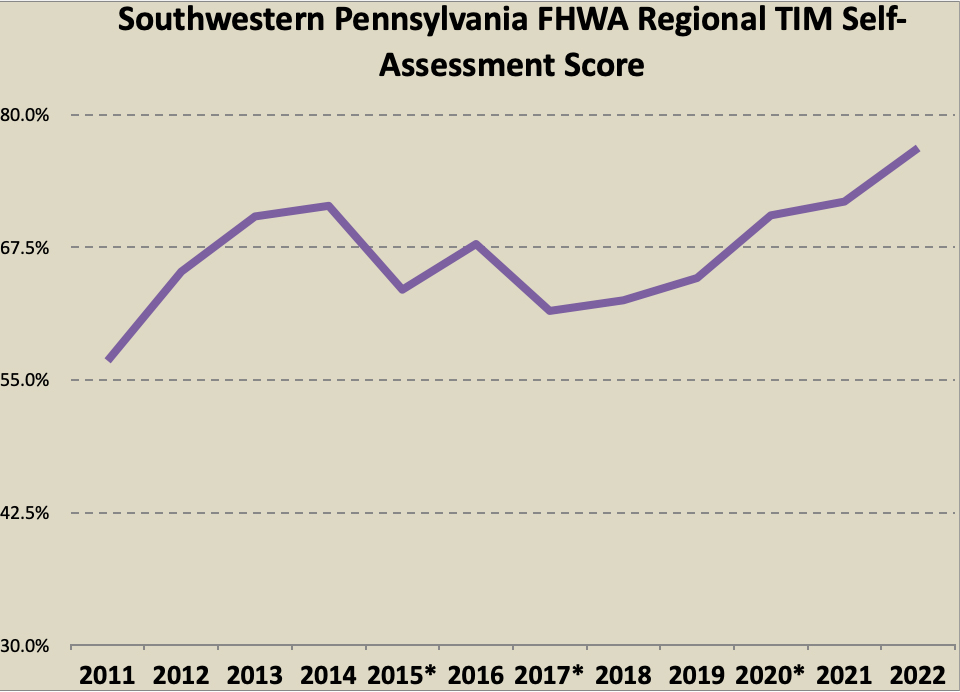
This TIM Self-Assessment provides a formal process for state and local transportation, public safety, and private sector partners to collaboratively assess their TIM programs and identify opportunities for improvement.  The assessment is conducted annually in each of the largest 75 urban areas.  Each year the new assessment is compared against previous years to evaluate *progress in our TIM program. (See below for our progress since 2011)

FHWA TIM Capability Maturity Self-Assessment (PDF)

A line graph is shown tracking the SPC FHWA Regional TIM Self-Assessment Score

* In 2015 and 2017, more specific scoring for each question was added and therefore may see a score decrease.


Resources


Regional Traffic Signal Program

Our Regional Traffic Signal Program provides technical assistance, and potential funding to municipalities throughout our region.

Since 2008, SPC and our planning partners have been assisting local governments with improving traffic signal operations by optimizing traffic signal timings and upgrading existing traffic signal equipment. We have now completed the third cycle of this important regional program. Together the three cycles have invested nearly $11 Million to improve traffic signals in the region and results have yielded $51 of public benefit for every $1 spent in terms of reduced delay, reduced vehicular stops, reduced fuel consumption, and reduced emissions.

A summary of the benefits and costs of this program can be found here.

Visit our YouTube Channel to view Before/After Retiming Videos & Project Summaries


Resources

Traffic Signal Retiming Videos

Traffic Signal Project Summaries


Transportation Operations & Safety Forum

Our Transportation and Operations and Safety Forum meets 3 to 4 times per year and  brings together traffic engineers, safety professionals, and transportation planners from around the region to collaborate and share information on projects that work toward improved efficiency and safe operation of the transportation system.  We continue to lead planning for safe and effective transportation operations in Pennsylvania


Resources

Meeting Materials


Congestion Management Process

Federal transportation legislation requires that each metropolitan planning area in the United States have a Congestion Management Process, or CMP.  The CMP is a regional program to address and manage congestion within the 10-county Southwestern Pennsylvania region in order to facilitate the movement of people and goods.

The goal of the CMP is to provide information that helps transportation planners, professionals and others to understand the overall congestion climate in individual corridors and the region. Data on the congestion climate helps us, in partnership with other agencies, to formulate congestion management strategies. Data and information from the CMP benefits the transportation planning process by helping the region focus limited federal transportation dollars where they can have the greatest impact.


Special Studies


Resources


Intelligent Transportation Systems

We participate in statewide and national discussions concerning advancements in Intelligent Transportation Systems (ITS), including a statewide connected and autonomous vehicle work group on emerging technologies.


Resources


Regional Operations Plan

We continue to work with our partners to implement initiatives from the seven priority areas contained in the 2019 Regional Operations Plan.


Resources


Highway Safety Improvement Program (HSIP)

The Highway Safety Improvement Program (HSIP) is a core Federal-aid program with the purpose to achieve a significant reduction in traffic fatalities and serious injuries on all public roads, including non-State-owned roads and roads on tribal land. The HSIP requires a data-driven, strategic approach to improving highway safety on all public roads with a focus on performance.  The goals of the program is to address PA Strategic Highway Safety Plan (SHSP), project selection by Data Driven Safety Analysis (DDSA), and HSIP Set-Aside project solicitation. 

2025-2026 HSIP Set Aside Projects.


Resources


Road Safety Audits

We have developed a RSA program for Southwestern Pennsylvania as part of our Transportation Operations and Safety planning efforts.  Road Safety Audits examine of existing or future roads using an independent, multidisciplinary team to identify potential road safety issues and opportunities for proactive safety improvements. SPC integrates safety evaluations into managed funding programs.

Resources


Leader Times: SPC hosts public meeting to gather feedback on the Transportation Improvement Program

The road to completing transportation improvement-related projects is most crucially paved with governmental funding dollars.

Appreciation for efforts to acquire such funding from the state and federal levels, particularly as it pertains the three ongoing initiatives in Armstrong County, represented a fair portion of the detail and dialogue voiced during Tuesday’s public meeting of Southwestern Pennsylvania Commission (SPC) leaders to gather feedback from county residents, which was held at Kittanning Township Volunteer Fire Dept.


“Armstrong County, per capita, had some of the worst secondary roads in the commonwealth, and over the last two years we’ve seen $5 million last year and $5 (million) coming this year … to get some funding back here,” said county Commissioner Pat Fabian, SPC chairman, in reference to the continuation of a two-year, $10 million investment in the county’s secondary road infrastructure advocated by State Sen. Joe Pittman (R-41).

The state routes targeted include 37.7 miles of passages in Burrell, Kittanning, Manor, Plumcreek, South Bend and Bethel townships.

Such action is largely dependent on needs expressed to decision-makers by members of the public, Fabian stressed.

“This feedback that we get today … this review of this TIP (2025-28 Transportation Improvement Program) is important … for us, as county commissioners, and the (state’s) southwest region, to go after state and federal dollars to improve our transportation system out there,” he added.

Active projects on the SPC’s current TIP (2023-25) in county that were initially highlighted during the event, by Ryan Gordon, SPC manager of transportation planning, included:

• Margaret Road Intersection — Reconstruction of a portion of US 422 near the intersection of SR2005 (Margaret Road/Cherry Run Road) to include the construction of a new two-span continuous steel multi-girder bridge to carry US 422 over SR2005 and a new precast concrete box culvert, with an estimated completion date of May 25, 2025, and a construction cost of $28.6 million.

“Big project, as everybody knows … we never had enough money to put a four-lane in from Kittanning to Indiana. We’re going to do safety enhancements along the Route 422 corridor,” said Harold Swan, PennDOT District 10 planning and project manager. “This happens to be an improvement to the past improvement we made, and (we’re) trying to eliminate more traffic backups. We appreciate our local representatives and senators … Sen. Pittman helped us in getting (this funding). These were not funds out of our TIP. Much appreciated, because (that would have been) a big chunk for us out of our TIP funds. That $28 million, that’s a third of our TIP funds for the year.”

  • Goheenville Dip — Safety improvements including roadway realignment, bridge replacements, continuation of a truck-climbing lane, and turning lanes at intersections along PA 66 in Boggs and Wayne townships, with an estimated completion date of Nov. 22 of this year;
  • “I think this is the beginning of good things to come,” said Swan, with regard to the enhanced potential for safety designed to ensure via the project.
  • Poverty Hill Bridge — Replacement of existing structure carrying State Route 28 over a branch of Cowanshannock Creek in Rayburn Township, as construction is in the process of being completed at a cost of $3.8 million.

Gordon added: “We are actively managing (the SPC’s current TIP) almost daily, working with our PennDOT districts and our project sponsors. We meet monthly as a transportation technical committee, which Armstrong County attends and has a vote there. We’re constantly managing this for the most efficient use of our public funds for transportation. We’re constantly adjusting things as we need.”

Funding is required to fuel all phases of each project, from study phases and preliminary engineering and all the way through construction.

PennDOT District 10 officials, along with State Rep. Abby Major (R-60) and State Rep. Donna Oberlander (R-63) and representatives of the offices of U.S. Rep. Glenn “GT” Thompson (R-15) and Pittman.

During the meeting’s public comment segment, Bradys Bend Township Supervisor Frank Bratkovich asked how realistic it is for a smaller municipality, such as the one he is elected to represent, to be eligible for funding to complete its own projects of a TIP nature.

“I’m assuming this is going to take place where the bridges are bigger — where there is more traffic,” Bratkovich added.

Gordon responded by saying the SPC tries to include, where possible, projects to improve bridges, for instance, if the need is severe.

“We work closely with PennDOT District 10’s bridge unit. They kind of have a handle on the bridges that are in the worst condition, and we try to kind of target it that way,” he said.

In terms of roadway improvements in smaller municipalities?

“Roadways? No. For roadways, our items that are on this TIP only go to the federal aid network, which is not the local system. The local system is funded through a different manner, through liquid fuels funding, to a municipality,” Gordon said.

Fitzgerald encouraged Bratkovich and other leaders in smaller municipalities “not to be dissuaded from applying.”

“Just because it might not be this program, there are multiple programs for funding roads and bridges that could be used, so we would encourage you to contact your commissioners, your state legislators, you state senators, as an elected official, to let them know of your needs, and that you want to put in for a grant, and there are ways to get there. This isn’t the only option that’s there,” Fitzgerald added.

County citizen Rick Drumm questioned where the funding was coming from, and whether the SPC officials are making it adequately known if the money is largely the result of federal infrastructure bills being pushed through by the Biden administration.

“There are a lot of pots of money that it comes from, primarily from obviously the state and federal government … our friends from PennDOT … that the legislature and the governor appropriate, and obviously out of Washington that the Congress and the President appropriate,” Fitzgerald said.

He added that a lot of the appropriated dollars, unfortunately, has been eaten up, of late, but inflation-related increases in costs to materials and other resources.

SPC’s 2025-28 TIP is detailed

The meeting was also used as a forum to provide details of a working draft of the SPC’s 2025-2028 TIP.

During the TIP period (2025-28), approximately $4.5 billion in state, federal, and local funds will be invested throughout the next four years to improve infrastructure/transportation system throughout the next several years in Armstrong County and 10 other counties in the SPC-represented region.

The event served as part of a public comment period to gather feedback from the public.

The public meetings that SPC officials host are part of a 30-day public comment period.

As the region’s metropolitan planning organization (MPO), SPC officials are responsible for drafting the region’s long-term and short-term transportation plans, in conjunction with leaders of member counties and the state’s department of transportation (PennDOT).

As part of the SPC’s work, its officials develop a Long-Range Transportation Plan (LRTP) that provides Southwestern Pennsylvania with specific infrastructure and transportation initiatives that need addressed throughout the next 25 years.

The LRTP is implemented with a series of shorter-term investment plans, or TIPs.

During the TIP period (2025-28), over $4.5 billion in state, federal, and local funds will be invested to improve our region’s transportation system over the next four years.

Editor’s note — If a member of the public was not able to attend the meeting, but would still like to provide their opinion, they are invited to submit their comments during SPC’s public comment period (which runs until June 7). The public can submit comments by email at: comments@spcregion.org — or mail hard copy comments to Southwestern Pennsylvania Commission’s address at 42 21st St., Suite 101, Pittsburgh, PA 15222, or they can compete an online comment form available at: spcregion.org/get-involved.

View the full story at leadertimes.com.


SmartMoves: Long Range Transportation Plan & Transportation Improvement Program

SmartMoves LRP | 2027-2030 TIP

2023 SmartMoves Long Range Transportation Plan Documents

Orange and Grey "Smart Moves For A Changing Region" logo

The SmartMoves for a Changing Region transportation and development plan identifies the region’s priority roadway, transit and multimodal transportation improvements programmed for advancement over the next 25-30 years.

Publications and Resources


2027-2030 Transportation Improvement Program (TIP) (to take effect on October 1st, 2026)

The region’s long range transportation plan is implemented with a series of shorter-term investment plans, known as Transportation Improvement Programs, or TIPs. Each TIP is a step along that 25-year investment in our region’s future.

The 2027-2030 TIP is comprised of projects and programs that serve multiple transportation modes and connections in our region.

Publications and Resources


Public Transit-Human Services Coordinated Transportation Plan (CTP)

Federal transit law requires that projects selected for funding under the Enhanced Mobility for Individuals and Individuals with Disabilities Program (49 U.S.C. 5310) be “included in a locally developed, coordinated public transit-human services transportation plan.” The plan is required to be “developed and approved through a process that included participation by seniors, individuals with disabilities, representatives of public, private, and nonprofit transportation and human services providers and other members of the public” utilizing transportation services.

Transportation Technical Committee (TTC)

Our TTC deals exclusively with technical issues relating to transportation. It makes recommendations to SPC and the Policy Committee regarding the Transportation Improvement Program, transportation-related air quality plans, and transportation issues.

The Committee includes the planning directors of the ten SPC member counties, the City of Pittsburgh, and representatives of PennDOT Central Office, Pennsylvania DEP, and the PGH Regional Transit. Nonvoting members of the Committee include PennDOT District Offices, FHWA, FTA, EPA, and the Allegheny County Bureau of Air Pollution Control.

Resources


The Leader Times: Southwestern Pennsylvania Commission hosts public meeting to gather information from Armstrong County residents on transportation and infrastructure issues

Members of the Southwestern Pennsylvania Commission (SPC), met on Tuesday at the new Butler County Community College in Ford City to collect public input for their long-range transportation plan.

The plan they are updating, according to an SPC press release, called SmartMoves for a Changing Region, was adopted in June 2019 and included more than $35 billion in regional transportation priorities for the next 25 years.


Caitlin O’Connor, SPC media point of contact, wrote in the release that the SPC is the area’s designated metropolitan planning organization and works closely with the 10 counties in Southwestern Pennsylvania, including Armstrong County.

The agency also works closely with PennDOT on road improvement projects.

Ryan Gordon, manager, transportation program development for the SPC, presented a PowerPoint presentation about the plan during the meeting.

He said SmartMoves for a Changing Region includes a regional vision of a world-class, safe and well maintained, integrated transportation system that provides mobility for all, enables resilient communities and supports a globally competitive economy.

To achieve this vision, the long-range plan includes a list of projects currently within fiscal capacity and projects beyond the fiscal capacity, he said.

Mr. Gordon said the Regional Vision includes three major categories, including: transit projects, such as a West Busway Bus Rapid Transit (BRT) extension to Pittsburgh International Airport and an East Busway extension to the east suburbs and the Mon Valley, among other projects.

The Regional Vision also includes an active transportation category, or funds for walking/biking trails and filling in gaps between trails, he said.

The active transportation category includes extending the Three Rivers Heritage Trail to Freeport; and connecting the Westmoreland Heritage Trail to the Great Allegheny Passage, the bike trail that runs through Homestead, among other projects.

The third category is roadways, that is, highway improvement projects such as the modernization of U.S. Route 30.

The Long-Range Transportation Plan (LRTP), lasts 25 years, and is updated every four years.

When projects are moved from the LRTP to the short-term, two-year TIF (Transportation Improvement Program), it means those projects will soon be started, or are, in the case of the Margaret Road intersection, already underway.

Other Armstrong County projects moved to the 2021 or 2023 TIF list include preservation work on the Judge J. Frank Graff Bridge; rehabilitation of the 1/112th Infantry Bridge and Graff Ramp; Armstrong State Route 28 group bridge rehabilitations; and safety improvements to the Goheenville Dip.

According to Mr. Gordon’s PowerPoint presentation, Armstrong County projects in the current TIP include the Poverty Hill Bridge, work on the State Route 85-State Route 2001 intersection, U.S. Route 422 concrete preservation, Rural Valley Bridge #4, Brick Church Bridge #2, and the Pyra Road Bridge.

He said the projects will also be evaluated from an “environmental justice” perspective, which helps ensure projects do not negatively impact minority communities.

Enhanced broadband is also important and a needed improvement, Mr. Gordon said.

After the meeting, Harold Swan, a planning and programming manager for PennDOT, said improvements on State Route 28 north of Kittanning will likely include turning lanes and other work to make the road safer.

Darin Alviano of the Armstrong County Planning and Development office said the county is concerned with projects to the north, east, and in all parts of the county, not just in Kittanning.

Jeremy Dias of state Sen. Joe Pittman’s office submitted the following statement about the meeting between SPC staff members, local officials and PennDOT representatives:

“Sen. Pittman is always pleased to advocate and work to secure funding that addresses critical infrastructure needs within the 41st Senatorial district,” he wrote. “We are grateful for the partnerships that exist with PennDOT, SPC and Armstrong County and for their efforts to help advance transportation projects within the region.”

Public input

If a member of the public wasn’t able to attend the meeting, but still wants to provide their perspective on the transportation plans and issues, SPC members invited them to submit their comments before June 9.

Citizens can submit their comments either by email at comments@spcregion.org, by submitting an online form by fax at 412-391-9160; or by mailing comments to the Southwestern Pennsylvania Commission’s address at P.O. Box 101429, Pittsburgh, PA, 15237.

An SPC spokeswoman said SPC staff people respond to every comment.

View the full article at leadertimes.com


Our Team

Leadership | Staff | Departments

Click on the photo to read the biography and obtain the contact information for each staff member. If you aren’t sure which staff member to contact, scroll to the bottom of this page to find the email addresses for each program.

Leadership

Staff

Departmental Contacts

Active Transportation

atrc-spc@spcregion.org

Climate Pollution Reduction Implementation Grants

cprg@spcregion.org

Communications and Public Outreach

comments@spcregion.org 

Economic Development

Economicdevelopment@spcregion.org

Operations and Safety

opsandsafety@spcregion.org

Sponsored Programs Management Office

SponPrgmsMgmt@spcregion.org

Transport Programming

transportprogramming@spcregion.org

Water Resource Center

wrc@spcregion.org


Southwestern Pennsylvania Commission Unveils New Safety Plan Duo

FOR IMMEDIATE RELEASE
July 1, 2025

The Southwestern Pennsylvania Commission (SPC) is proud to announce the approval of two transformative plans on June 23, 2025, aimed at improving transportation and safety across the 10-county region.

The Active Transportation Plan (ATP) is a cutting-edge tool tailored for industry professionals, planners, and engineers. This interactive story map offers detailed data, maps, and resources to support the development of bike lanes, pedestrian pathways, and other active transportation projects. The ATP aims to improve connectivity and promote healthier, more sustainable travel options, making it an invaluable resource for shaping the region’s future mobility. It is available for online viewing and usage here.


Complementing the ATP, the Regional Safety Action Plan (RSAP) addresses a critical need for safer roads across SWPA. This comprehensive document outlines strategies to reduce traffic crashes, enhance pedestrian safety, and upgrade infrastructure, impacting everyone from daily commuters to cyclists. Accompanied by a series of engaging videos, the RSAP highlights real-world safety improvements, offering a visual testament to SPC’s dedication to protecting all road users. The plan builds on recent regional safety data, aiming to address high-risk areas identified through community input and analysis. It is available for online viewing here.

SPC invites the public, industry professionals, and local leaders to explore these plans and provide feedback as implementation begins. Videos and additional resources will be shared on SPC’s social media channels in the coming days.

Media Inquiries: DJ Ryan
Cell:  412-478-1928 
DJRyan@spcregion.org

###

About Southwestern Pennsylvania Commission:
The Southwestern Pennsylvania Commission, more commonly known as SPC, is the cooperative forum for regional collaboration, planning, and public decision-making for the ten counties of Southwestern Pennsylvania including the City of Pittsburgh. SPC develops plans and programs for public investment and fulfills federal and state requirements for transportation, economic development, and local government assistance programs.

PRESS RELEASE DOWNLOAD (PDF)