Multimodal Transportation

Multimodal transportation networks provide safe, sustainable travel for all users and differing levels of mobility. Comprehensive multimodal planning is accomplished through several of our programs.

Active Transportation | Freight | SmartMoves Connections | TDM | TOC

Active Transportation

Walking and biking have positive benefits on
the environment, economic development, health, safety and overall quality of
life for residents within the region.

Active Transportation Plan Update Story Map and Companion Documents


Additional Resources


Freight

Recognizing the role of freight in local
economic development, we assist in attracting emerging industries, building
enhanced connections to the global marketplace, and protecting mobility options
to our commercial and industrial partners.

SPC uses information gained from its Freight
Forum in the design and implementation of freight-specific roadway
improvements, and in the evaluation of applications for state and federal grant
funding.


Resources


SmartMoves Connections: A Regional Vision for Public Transit

With SmartMoves Connections, SPC presents a new approach to regional transit planning—one based on locating the Transit Supportive Land Uses already present in our region. Using a Machine Learning analysis of aerial photography and travel data, SmartMoves Connections maps the clusters of land with multimodal potential. These are put into six categories where Multimodal Hubs and Multimodal Corridors could be good mobility options.

A Multimodal Hub is a facility where mobility services can connect together—such as Park-and-Ride, bike lockers, scooter-share or paratransit—along with public transit service. These Hubs allow seamless connections between the parts of a person’s trip and enable new kinds of trips, even across county borders or on multiple transit services.

Multimodal Corridors improve the speed and reliability of transit service with improvements like Transit Signal Priority, exclusive bus lanes, queue jump turn lanes, protected bike lanes and improved stations. With the SmartMoves Connections Cluster Map, you can see what multimodal improvements would work best for the place you are interested in. To learn more, download the report or view the story map .

For questions about SmartMoves Connections, contact Devon White  at dwhite@spcregion.org.


Resources


Transportation Demand Management

Transportation demand management focuses on the decisions that people and businesses make every day about how they travel. Managing travel demand involves providing travelers with information, options, and incentives that expand travel choices beyond driving alone, such as use of transit, ridesharing, bicycling, walking, and teleworking. For those who drive, it also involves shifting travel to less congested times or routes, or avoiding trips entirely in order to reduce traffic congestion, improve system efficiency, and enhance quality of life.

TDM Action Plan

This plan will establish and prioritize goals and strategies that build upon existing efforts and programs to improve mobility options by:

  • Maximizing the efficiency of the region’s existing infrastructure.
  • Better integrating TDM initiatives with regional and local transportation planning.
  • Developing focused TDM planning strategies into operations and safety, sustainability as well as economic and community vitality.
  • Enhancing the region’s existing communities by supporting connections to transit, walking and bicycling.
  • Coordinating TDM activities among all of the region’s TDM implementers and stakeholders in order to maximize investment and to deliver consistent, complimentary strategies.

This plan will also support and implement the vision, policies and goals in the region’s Long-Range Transportation Plan, SmartMoves for a Changing Region


Resources


Transit Operators Committee (TOC)

The Transit Operators Committee provides technical assistance to our by serving as the forum for advancing programs and projects providing public transportation options, regional transit coordination, alternatives to fixed-route transit service, and economic opportunities linked to land use and transit-oriented development. Committee membership consists of representation from the region’s sponsors of public transportation; the regional vanpool sponsor, CommuteInfo; and, the three Allegheny County Transportation Management Associations:

Allegheny County
PGH Regional Transit
Phone: 412-442-2000

Airport Corridor Transportation Association
412-533-4600

Pittsburgh Downtown Partnership
Phone: 412-566-4190

Oakland Transportation Management Association
Phone: 412-779-5398

Armstrong County
Town & Country Transit
Phone: 724-548-8696 or 1-800-245-8588 (toll-free)

Beaver County
Beaver County Transit Authority (BCTA)
Phone: 724-728-8600

Butler County
Butler Transit Authority
Phone: 724-283-0445

Fayette County
Fayette Area Coordinated Transportation (FACT)
Phone: 724-430-4600 or 1-800-321-RIDE (toll free)

Indiana County
Indiana County Transit Authority (IndiGO)
Phone: 724-465-2140 or 1-800-442-6928 (toll-free)

Lawrence County New Castle Area
New Castle Transportation Authority
Phone: 724-654-3130

Mon Valley
Mid Mon Valley Transit Authority
Phone: 724-489-0880

Washington County
Freedom Transit (Washington County Transportation Authority)
Phone: 724-223-8747

Westmoreland County
Westmoreland County Transit Authority
Phone: 724-834-9282 or 1-800-221-9282 (toll free)


PennDOT Bureau of Public Transportation Annual Performance Report

For a quick reference of regional transit statistics, please visit penndot.pa.gov and view the PennDOT Bureau of Public Transportation Annual Performance Report.

TOC Resources


Pittsburgh Business Times: 20 People to Know in Transportation and Infrastructure: Leann Chaney, Southwestern Pennsylvania Commission

Leann Chaney, senior active transportation coordinator at the Southwestern Pennsylvania Commission, works with stakeholders looking to advance active transportation such as biking and walking within the SPC’s 10-county region. She provides technical guidance to help local governments achieve their active transportation goals and improve safety, comfort and connectivity. She also manages SPC’s nonmotorized data collection program, implementing the Regional Active Transportation Plan for Southwestern Pennsylvania and sponsoring a quarterly Active Transportation Forum.


How did you end up working in active transportation, and what attracted you to the field?
I prefer biking or walking for short trips and often bike to work, so the idea of advancing active transportation was appealing to me. Active transportation plays a crucial role in public transportation and transportation demand management strategies and is integral to many aspects of the work we do at SPC.

In what ways can active transportation be incorporated into projects funded by the Infrastructure Investment and Jobs Act moving forward?
There are numerous opportunities to incorporate active transportation into plans, policies and infrastructure projects. Bicycle and pedestrian infrastructure can be incorporated into roadway and other infrastructure projects by embracing Complete Streets principles and using innovative design guidelines to develop contextually appropriate multimodal solutions.

What has been the most gratifying aspect of your career?
Knowing that more people of all ages and abilities can safely bike, walk or roll to get to everyday destinations because new bike lanes, trails or sidewalks were installed or because street crossings were improved brings a sense of fulfillment, knowing you’ve played a part in fostering positive change.

What emerging technologies do you see as having the most significant impact on active transportation?
Rates of active transportation have increased nationally over the past several years, driven by improved walking and bicycling infrastructure and emerging technologies like electric bikes and micromobility solutions, like scooters. E-bikes make biking accessible to a wider range of people, and scooters provide convenient options for short trips, particularly in urban areas.

What book are you currently recommending to friends?
“The Death and Life of Great American Cities” by Jane Jacobs — one of the most influential works in community planning.

View the full article at bizjournals.com.


Careers

SPC’s Current Job Openings

Manager, International Trade Export Assistance | Active Transportation Manager | Models and Data Analysis Intern (ONSITE) | GIS Intern (ONSITE) | Active Transportation Intern (ONSITE)

Manager, International Trade Export Assistance

General Purpose:

Develop and implement programs to promote international trade throughout the region. Provide professional consulting services to small and medium sized businesses and develop relationships regionally and internationally.

Essential Functions:

  • Develop programs including budgets and work plans.
  • Promotes international trade among small and medium sized businesses within the region by developing, coordinating and providing networking opportunities, trade shows, seminars and training, trade mission opportunities, and other collaborative activities.
  • Provides consultation services to businesses including the development of export business plans, market entry strategies, market research, and general assistance.
  • Oversee day-to-day operations of the International Trade team by coordinating schedules, monitoring attendance, conducting regular performance evaluations, supporting ongoing training and professional development, addressing performance or conduct issues, and ensuring staff follow safety, service, and operational standards.
  • Promotes and manages compliance with external grant programs.
  • Builds partnerships between regional export professionals through networking, roundtable discussions, and other focus type events.
  • Prepares and submits all required reports and work plans to Sr. Management and funding agencies related to the International Trade export assistance Program.
  • All other duties as assigned by directors.

Education / Experience Requirements:

  • Master’s degree in international business, Business Administration, Economic Development, or a closely related field required.
  • Minimum of five (5) years of relevant experience, including at least two (2) years in a management role.
  • Demonstrated experience in public speaking and business consulting.
  • At least two (2) years of experience working with public officials and public funding programs.
  • Knowledge of federal and state funding structures and regulations.
  • Proficiency in Microsoft Office Suite.
  • Bilingual or second-language proficiency preferred.

Physical Requirements:

  • 60% Sitting, 20% Standing, 20% Walking, 60% Use of Fingers, 85% Talking / Hearing, Lift < 10lbs, Near vision

Skills:

  • Implementation Planning, Judgment & Decision Making, Reading Comprehension, Information Gathering & Organization, Idea Evaluation & Generation, Critical Thinking, Solution Appraisal, Writing, Speaking, Administration & Management

Knowledge:

  • Sociology, English Language, Government Regulations, Economics, Business Globalization

Abilities:

  • Written & Oral Comprehension, Deductive Reasoning, Speech Clarity

Work Environment:

  • Works in an environmentally controlled clean office.

SPC is proud to offer staff and their loved ones an impressive benefits experience, providing focused support on their physical, emotional, and financial well being. Benefits include:

  • Medical, Dental, Vision and FSA
  • 403B options and company sponsored pension plan
  • Vacation time, sick time and personal leave
  • 11 Paid Holidays
  • Flexible hybrid work schedule
  • Tuition assistance

To Apply:

  • Email letter of interest and resume to: hr@spcregion.org
  • SPC provides competitive compensation, including an excellent benefits package, flex time, mileage reimbursement, holiday/vacation pay and more.

Active Transportation Manager

General Purpose:

Leads in the development, implementation and administration of select commission transportation related programs and projects.  Develops and delivers oral and written reports and presentations to internal and external audiences. Supports, develops and implements the efforts of TDM (Transportation Demand Management) including outreach to provide information on travel demand management strategies and alternate modes of transportation, specifically active transportation modes.

Essential Functions:

  • Oversee day-to-day operations of the active transportation team by coordinating schedules, monitoring attendance, conducting regular performance evaluations, supporting ongoing training and professional development, addressing performance or conduct issues, and ensuring staff follow safety, service, and operational standards.
  • Serves as a liaison with the public, and various other agencies promoting regional active transportation planning at the local, state, and national levels.
  • Researches, compiles, analyzes and coordinates technical and policy area information pertaining to the agency’s program activity, specifically those related to active transportation modes.
  • Applies federal and state transportation planning regulations in the development of communications concerning the agency’s program activity internally and externally via oral and written communications.
  • Assists in developing and implementing work plans for various TDM services/initiatives including active transportation. Assists state and local planning partners with active transportation plans including data/mapping needs. Assist region’s trail groups and associations with data needs and planning.
  • Maintains and updates data and files on program activity. Works with data team to collect new pedestrian/bicycle data on facilities throughout region.
  • Develops, reviews and edits select reports and technical memorandums. Working with regional stakeholders, has primary responsibility for updates to the Active Transportation Plan and the Active Transportation Resource Center website.
  • Processes and summarizes input and communications for possible inclusion in plan and program development.
  • Plans, prepares, and staffs both technical and specialty meetings.
  • Develops and maintains partnerships with other planning agencies within the region, including trail groups, advocacy groups, nonprofits and state agencies
  • Writes Requests for Proposals, evaluates bids, and recommends consultants to implement strategies that advance TDM programs and policies, with a focus on active transportation.
  • Reviews work of outside contractors to monitor progress on select projects.
  • Applies knowledge of federal and state transportation funding to advise partners and provide technical assistance on funding opportunities.
  • Coordinates and collaborates with PennDOT Pedestrian/Bicycle Coordinator and other MPO/RPO bicycle and pedestrian coordinators.
  • Works with Operations and Safety team on Road Safety Audits, Pedestrian and Bicycle Road Safety Audits and other operations and safety initiatives as required
  • All other duties as assigned by Supervisor. Reports directly to the Director of Transportation Planning

Education / Experience Requirements:

  • Bachelor’s degree in planning, Engineering, Public Administration or other closely related field required. Masters degree preferred.
  • Five (5) years’ experience in management, project management or supervisory role.
  • American Institute of Certified Planners (AICP) certification preferred.
  • Eight (8) years of transportation planning experience.
  • General computer skills with the ability to learn new software applications.

Physical Requirements:

  • 75% Sitting, 10% Walking, 15% Standing, 80% Use of hands, 5% Reaching 90% Talking / Hearing; Lifting < 10 lbs.; Near vision, Color vision

Skills:

  • Reading Comprehension, Information Gathering, Critical Thinking, Information Organization, Implementation Planning, Identifying Downstream Consequences & Key Causes, Writing, Speaking, Synthesis/Reorganization, Active Listening, Problem Identification, Coordination, Judgment & Decision Making, Idea Generation & Evaluation, Systems Perception

Knowledge:

  • Mathematics; Sociology; English Language; Law, Government & Jurisprudence; Administration & Management

Abilities:

  • Reading Comprehension, Information Gathering, Critical Thinking, Information Organization, Implementation Planning, Identifying Downstream Consequences & Key Causes, Writing, Speaking, Synthesis/Reorganization, Active Listening, Problem Identification, Coordination, Judgment & Decision Making, Idea Generation & Evaluation, Systems Perception

Work Environment:

  • Works in an environmentally controlled clean office.

SPC is proud to offer staff and their loved ones an impressive benefits experience, providing focused support on their physical, emotional, and financial well being. Benefits include:

  • Medical, Dental, Vision and FSA
  • 403B options and company sponsored pension plan
  • Vacation time, sick time and personal leave
  • 11 Paid Holidays
  • Flexible hybrid work schedule
  • Tuition assistance

To Apply:

  • Email letter of interest and resume to: hr@spcregion.org
  • SPC provides competitive compensation, including an excellent benefits package, flex time, mileage reimbursement, holiday/vacation pay and more.

Models and Data Analysis Intern (ONSITE)

Job Summary:

SPC is seeking an intern for its Models & Data Analysis Unit to assist with various ongoing projects in need of transport modeling, data collection, data management, database development, data analysis, and related activities.

Key Responsibilities:

  • Assist in coding of scripts (R, Python, etc.) to automate current manual processes.
  • Help develop and review content for SPC’s Regional Data Center webpage.
  • Database management to integrate data from new sources into existing libraries.
  • Data analysis including preparation of charts, maps, tables, and infographics in support of other SPC Departments and projects.
  • Data entry and analysis to develop and update GIS layers to visualize characteristics of the region’s transportation network including roads, bridges, and freight facilities; public transportation routes and service levels; and bike and pedestrian infrastructure.
  • Assist with analysis of data from the US Census Bureau and other public data providers.

Qualifications:

  • Preferred candidates would be enrolled in an undergraduate or graduate program in Regional/Urban Planning, Geography, Civil Engineering, Information Science, Data Analytics, or related field with interests in Programming, Transportation Planning, Geographic Information Systems, and Transport Modeling.
  • Working knowledge and application of programming languages (such as R, Python, or similar) as well as completion of a college-level GIS course is strongly preferred.
  • Excellent written/oral communication and computer skills are also preferred.

Learning Objectives:

  • At the end of the internship, the intern will have a strong foundation in Models & Data Analysis.
  • Gain hands-on experience in a real business setting and learn key tasks.
  • Understand and contribute to team goals.

Physical Requirements:

  • 75% Sitting, 10% Walking, 15% Standing, 80% Use of hands, 5% Reaching 90% Talking / Hearing; Lifting < 10 lbs.; Near vision, Color vision

Work Environment:

  • Works in an environmentally controlled clean office. Working outdoors in inclement weather and a variety of environments may be required.

To Apply:


GIS Intern (ONSITE)

Job Summary:

The Southwestern Pennsylvania Commission (SPC) is seeking an Entry-Level GIS Intern to help in the development and rectification of key GIS datasets throughout our region.

Key Responsibilities:

  • Digitization, Data Entry, Research

Qualifications:

  • Currently enrolled in an undergraduate or graduate Planning, GIS, Geography program or a closely related field.
  • One (1) year experience with mapping, data reconfiguration and statistics.      
  • ESRI ArcGIS Suite Experience- Preferably ArcGIS Pro experience.
  • Microsoft Office Suite Experience- Access, Excel, Word

Learning Objectives:

  • At the end of the internship, the intern will have a strong foundation in creating, editing, and visualizing spatial data.
  • Gain hands-on experience in a real business setting and learn key tasks.
  • Understand and contribute to team goals.

Physical Requirements:

  • 75% Sitting, 10% Walking, 15% Standing, 80% Use of hands, 5% Reaching 90% Talking / Hearing; Lifting < 10 lbs.; Near vision, Color vision

Work Environment:

  • Ability to perform field work in environmental conditions that include exposure to outdoor elements (sun, wind, precipitation).
  • A personal vehicle will be required for use in travelling to counties throughout the Pittsburgh 10-county region.

To Apply:


Active Transportation Intern (ONSITE)

Job Summary:

The Southwestern Pennsylvania Commission is seeking an intern to contribute to our active transportation program.

Key Responsibilities:

  • Assist with provision of technical assistance for municipalities developing active transportation plans and/or advancing Safe Routes to Schools programs.
  • Assist with compilation and sharing of knowledge-based resources to support trail organizations with capacity and trail development needs.
  • Update website content for the Active Transportation Resource Center.
  • Assist with collection of bicycle and pedestrian counts and managing count data.

Qualifications:

  • Pursuing or recently completed a degree in planning, geography, GIS, public policy, transportation, or a related field.
  • Strong written and verbal communication skills.
  • Interest in active transportation, Safe Routes to School, trails, or multimodal transportation planning.
  • Ability to learn data collection techniques and use automated counting equipment. (training provided)
  • Experience with ArcGIS Pro and/or ArcGIS Online preferred.
  • Completion of at least one college-level GIS course preferred.
  • Experience with data collection, fieldwork, community engagement, or policy research preferred.

Learning Objectives:

  • Build a solid foundation in active transportation planning and implementation.
  • Gain firsthand experience in a professional planning environment.
  • Learn how regional plans, local projects, and policy initiatives work together.
  • Develop skills in data collection, GIS applications, analysis, and technical assistance.
  • Contribute to real-world projects that support municipalities and communities.

Physical Requirements:

  • 75% Sitting, 10% Walking, 15% Standing, 80% Use of hands, 5% Reaching 90% Talking / Hearing; Lifting < 10 lbs.; Near vision, Color vision

Work Environment:

  • Ability to perform field work in environmental conditions that include exposure to outdoor elements (sun, wind, precipitation).
  • A personal vehicle will be required for use in travelling to counties throughout the Pittsburgh 10-county region.

To Apply:


SPC is proud to be an Equal Opportunity employer. We value diversity among our applicants, staff, and commission, and invite applications from all qualified individuals regardless of race, ethnicity, color, religion, gender identity, sexual orientation, age, nationality, genetics, disability, or Veteran status.

SPC is committed to providing reasonable accommodation when necessary throughout our interview process. Please address these accommodations to our HR Director.

Creating an inclusive, engaged, and dynamic atmosphere is core to SPC’s mission. Service, Resiliency, Innovation, and Accountability are the core values that unite the SPC team, inspiring one another to work and support others as they seek to reach new levels of excellence.


Land-use webinar focused on Active Transportation

Last month, SPC Transportation Planner Leann Chaney presented “Planning for Active Transportation in Southwestern Pennsylvania”.

The webinar provided an overview of SPC’s recently adopted active transportation plan and companion, web-based toolkit known as the Active Transportation Resource Center. The Active Transportation Resource Center is a central clearinghouse for the latest information on active transportation. Resources include information on programs that support biking and walking, potential funding opportunities, design guidelines, and more.

“Planning for Active Transportation in Southwestern Pennsylvania” was the first webinar in the Penn State Extension Winter/Spring 2020 Land-Use Webinar Series that runs through May. The series informs municipal elected and appointed officials, planners, landowners, farmers, and community organizations about land-use issues and decisions in their communities.


View the full webinar here.

Press Release


PennDOT to host Online Public Forum on 12-Year Program (TYP) Update

The 2023 Public Comment Period for the update of the PennDOT 12-Year Program (TYP) is underway and all Pennsylvanians are encouraged to get involved in this important transportation planning effort!

To provide Pennsylvanians with every possible opportunity to get involved and make their voices heard, a Transportation Survey is open for public input.


In addition to the Survey, PennDOT will also host an Online Public Forum on Wednesday, April 12, from 6:30 – 8:00 PM, featuring a presentation from PennDOT leadership and members of the STC, followed by a Q&A session.

Important Dates

Public participation and support ensures a diverse range of comments from across PA and facilitates valuable data for all Transportation Improvement Programs.

Email comments to RA-PennDOTSTC@pa.gov, or call 717-783-2262 to request a printed copy or to complete the survey by telephone.

Visit TalkPATransportation.com to learn more!


PennDOT Invites Public Review, Comment on 2021 Transportation Performance Report

Pennsylvanians can view ratings of the state’s efforts in transportation safety, mobility, system preservation, and accountability in the Pennsylvania Department of Transportation (PennDOT) 2021 Transportation Performance Report (TPR), viewable at TalkPATransportation.com.

The TPR is a biennial report and is developed in a combined effort between the State Transportation Commission (STC), the State Transportation Advisory Committee (TAC), and PennDOT. The report is the first step in the state’s transportation program planning process and helps to evaluate the system’s performance and opportunities for progress.


“The Transportation Performance Report highlights PennDOT’s progress across major aspects of our system including safety, mobility, preservation, accountability, and funding,” PennDOT Secretary and State Transportation Commission (STC) Chair Yassmin Gramian said. “We will use this to help develop our next 12-Year program, as well as inform our Statewide Long-Range Transportation Plan and the Freight Movement Plan.

The release of the 2021 TPR also signals the start of the STC’s and PennDOT’s 2023 12-Year Program Update Public Comment Period. PennDOT conducts a statewide 45-day Public Comment Period every two years to collect public comment on multimodal transportation needs, issues, and concerns. The public feedback collected during the Public Comment Period is used to inform the 12-Year Program and other state and regional transportation plans and programs such as Pennsylvania’s Long Range Transportation Plan and the Freight Movement Plan.

The Public Comment Period will be open from Monday, March 1, through Wednesday, April 14. During this time the public will be able to submit feedback by taking a Transportation Survey, emailing comments to RA-PennDOTSTC@pa.gov, or calling 717-783-2262 from 7:30 AM – 4:00 PM to request a printed copy of the survey, or to complete the survey by telephone.

PennDOT’s Online Public Forum is set for Tuesday, March 23, from 6:30 PM to 7:30 PM. The Public Forum will be broadcast statewide via Zoom and Facebook Live and features PennDOT Transportation Secretary Yassmin Gramian.

The public will be able to submit transportation-related questions to PennDOT during the Public Forum. Questions may also be submitted in advance of the Public Forum by filling out the online registration form or by emailing RA-PennDOTSTC@pa.gov. The public may also call PennDOT and share their questions to be answered at the Public Forum at 717-783-2262 from 7:30 AM – 4:00 PM.


The Daily Courier: Fayette commissioners address issues at forum

Four candidates seeking three seats on the Fayette County Board of Commissioners participated in a forum at Penn State Fayette.

The event involved three incumbents, Republicans Scott Dunn and Dave Lohr, and Democrat Vincent Vicites, along with Democrat Geno Gallo.

The event was sponsored by the Fayette County Chamber of Commerce.


Each candidate made an opening statement and answered five questions delivered by a moderator.

Candidates each had two minutes to respond to each question.

The candidates received question topics in advance of the forum but not the actual questions.

Question 1: What are your priorities for the first six months in office?

“Growth is definitely something that you have to focus on,” Gallo said. “The reality is that the population is on the decline and continues to decline.”

Gallo said poverty is an issue that needs tackled along with the budget.

“Fundamentality, one of the biggest problems in the county is poverty,” Gallo said. “That poverty chases out the best and the brightest.”

Gallo said the budget needs to be controlled and expressed concern over the county’s purchase of several buildings that will now need to be maintained.

Gallo said the county’s spending has been excessive for the past 36 months, something that needs to be a priority.

“We need to keep spending under control,” Gallo said. “We need to take care of the people and really tighten the war on poverty. We can’t leave anyone behind.”

Dave Lohr said he will concentrate on the budget and tighten spending. He cited his past terms and the tackling of budget problems in the past.

“When I came into office which was almost eight years ago there were overspending issues,” Lohr said. “One thing that we did implement was tighter spending to make sure that the budget was within standings and where it was supposed to be and businesses got paid, people got paid.”

Lohr said the commissioners stayed busy during the COVID-19 pandemic, never stepping away from their responsibilities.

“We were on the job the entire time,” Lohr said. “We made sure that people were getting taken care of.”

Lohr said he is also proud of the work that has been accomplished in his seven-plus years in office.

“I am very good at making sure that things get done,” he said. “We put things in gear and we made things happen.”

Vicites cited the budget as a main concern. He said setting a budget is the first thing a commissioner needs undertake.

Vicites tackled what he called misinformation about commissioners’ spending over the past and presented the current budget as an example.

“Right now, at three-fourths of the year, at 75%, our budget right now in the county is at 62%. So we are well under in our spending,” Vicites said.

Vicites said the county received money through the federal American Rescue Act and for COVID relief. That money needed to be spent or else it would have to be returned to the federal government.

“We decided to invest in the courthouse,” Vicites said. “We invested in the future of the county and long-term growth and development in the county. Fayette County is on the move.”

Dunn said infrastructure and energy are important issues that require focus.

Dunn said any money received from federal or state governments adds to county revenue and those sources must be used for designated expenses, increasing county expenditures.

“Our budget has gone up but that is all special revenues and special projects. My focus is going to be on building infrastructure and what infrastructure means to me is not only water and sewage but broadband and energy in Fayette County,” Dunn said.

Dunn said the commissioners are working with Columbia Gas and West Penn Power to seek ways to boost energy as a way to bring in new business.

Dunn plans to focus on health care, energy, education, aquaculture and promoting and expanding tourism.

“I am leaving no stone unturned to make Fayette County a better place to live,” Dunn said.

Question 2: What is your priority in terms of budgeting?

“I have watched the budget tighten,” Lohr said. “We have meetings every month with the departments and we are consistently saying, ‘watch the budget.’ We do want to cut the spending. We want to make sure that wasteful spending is not taking place.”

Lohr said good bond rates have helped, and the commissioners work to keep the budget within range.

Vicites cited good interest rates the county received allowed the prison project to come in under the projected $44 million budget.

“We are actually about a million and a half under budget,” Vicites said .

Vicites said that every county department is well under budget and money received from other government sources has to be put into the county budget.

Vicites cited lack of funding from the state, which was slow in passing a 2023 budget.

“The last time I checked we were owed $5 million, so that does hurt our cash flow and we are doing everything that we can to cut costs,” Vicites said.

Dunn said commissioners have tried to keep a tight rein on spending.

“We have actually spent $1million less this year then we spent in last year’s budget,” Dunn said. “I am a big believer as we budget every year, no new people, no new equipment, no new cars, unless they are grant funded. Leave no stone unturned looking for grant funding.”

Dunn said the largest portion of annual budgets is for salaries, benefits and retiree benefits.

Gallo cited the expense of the new buildings purchased and cost to maintain them.

“That is a legacy of spending that will plague taxpayers for years to come,” said Gallo.

He said the expansion of government is unnecessary and costly.

“It doesn’t matter if it’s grant money or not. Grant money does not keep the lights on. We can’t go on with this broad-base spending. There is a cause and effect for everything,” Gallo said.

Question 3: How would you help tackle the shortage of skilled workers to ensure the business community can grow?

Vicites said heath care is a growing industry in the county and education and training are eeded to fill open positions and positions that may be created with the expansion of health care options in the county.

Vicites said the Appalachian Regional Commission provided the Fayette County Career and Technical Institute with a grant for health care training.

“Hopefully we can get that up and runningm get people trained for medical-related jobs and the jobs of the future,” Vicites said.

Vicites said the answer to the labor shortage program is workforce development.

“We have to train our people for the current jobs that are open, yrain them and fill them and also train them for the jobs of the future,” Vicites said. “I’m committed to whatever it takes to train people to get those jobs filled.”

Dunn said the growth of the health care industry is what will turn around the county.

“What has to happen is that we need to educate and train our people for these jobs,” Dunn said. citing opportunities at WVU Medicine Uniontown Hospital, Penn Highlands Connellsville, Independence Health System, the Allegheny Health Network and other health care facilities.

Dunn said the county offers educational opportunities at Penn State Fayette, Laurel Business Institute and Fayette County Career and Technical Institute.

“These entities are now working toward navigating our children toward more education,” he said.

Gallo said the problem is declining population.

“We have more jobs than people,” Gallo said. “We’ve got to get people to stay. Our best and our brightest are leaving us.”

Gallo said he wants to see more opportunities offered for county residents to become home buyers. He said what is needed is to address the problems with poverty head-on.

“People need to own their own homes,” Gallo said. “We got to get people in homes and we have to take care of our own.”

Gallo said that many smaller businesses are closing because of lack of labor.

“They can’t get labor,” Gallo said. “Our favorite mom-and-pop restaurants can’t get labor. We need to get people here and get them to stay.”

Lohr said ample opportunities are available for education and scholarships in the county. He said the problem with labor is not something limited to Fayette County.

“The whole country has this problem. You see help wanted signs everywhere. Everyone has the same issue. It’s not just us,” Lohr said.

Lohr said housing is an important matter.

“We need to work hard to make sure that housing is available,” Lohr said. “We have a shortage of houses.”

Question 4: What is the most pressing need for infrastructure or capitol projects and what will your focus be?

Dunn said being able to offer power generated on site for business is a must for growth.

“We can have power that is generated onsite and not coming from miles and miles away, and that is a microgrid,” Dunn said. “That is something that we have the ability to do right here in Fayette County and that is something that is very promising for Fayette County.”

Dunn targeted the need for clean water adding he has been working with companies to ensure everyone in the county has clean water.

Gallo said infrastructure is needed but the focus should be on realistic projects.

“Any kind of infrastructure that we do has to be smart and has to make sense in the long term,” Gallo said. “You can’t just keep spending money on development and ideas that don’t have a real payback for the people. If we focus on the people that are here that will give us the best results, what we need is a change of direction.”

Lohr said the infrastructure bank is important to the county.

Aimed at helping municipalities and municipal authorities fund infrastructure projects, the Fayette County Infrastructure Bank allows such entities to apply for loans from a special county fund to be used as a quicker, more reliable option for financing necessary repair or improvement projects.

“This is something that was put together in this term and this is something that I highly support,” Lohr said.

Lohr discussed the need for broadband in the county and said it is an extremely expense undertaking. Lohr said commissioners are seeking grants to help the process.

Vicites said broadband is a necessity and will become available to everyone in Fayette County.

“It is the infrastructure of the future,” Vicites said.

Vicites cited the number of projects already completed in including extensive road work and $200 million of economic investment in infrastructure projects.

Vicites said he is a member of the Southwestern Pennsylvania Commission which will have $5 billion for infrastructure available to Fayette County and other areas of the region.

“I will make sure that Fayette County gets its fair share if not more,” Vicites said.

Question 5: How will you assist with the health and wellness of communities?

Gallo said the county should embrace one of the its biggest industries — agriculture.

“We need to do more for our farms,” Gallo said. “We need to make sure that fresh food is getting in to the hands of Fayette County residents, fed by Fayette County farmers.”

“Poverty is our war here,” Gallo said. “We need to take care of our people here and others will come. Our quality of life is going down. I don’t want to be negative but we have to be realistic.”

Lohr said health is a concern across the board and that commissioners focused on the need to help diabetics and others with health problems to lead healthier lifestyles.

“We live here we see all the garbage,” Lohr said, adding illegal drugs are also a problem.

“The only thing that we can do is to continue to keep cleaning up the county,” he said.

Lohr addressed comments about declining county population.

“Population reduction is across the board but our.

He said people approach him daily about moving to the area. “I firmly believe that we will have people coming here,” he said.

Vicites said focusing on projects to keep people healthy is paramount.

“We need to live more healthy lives,” Vicites said, noting commissioners established a health-and-wellness program for county employees.

He said recreation available like the Sheepskin Trail, help people stay, getting in more exercise than ever.

“We have to continue to build our recreational opportunities to give people a chance to exercise,” he said.

Dunn said he believes in a comprehensive buy local program.

“The biggest problem we face is generational poverty,” he said.

“The more education and training you have the less likely you are to live in poverty, and the more likely you are to be employed in the work force,” he said. “We need to boost education and training and we need to navigate our students towards education.”

View the full article at dailycourier.com.


SPC to Host Virtual Small-Business Discussion Forum: “Building Economic Resiliency”

SPC is hosting a virtual Small Business Discussion and Forum on March 16th 2021 at 1:00pm. We want to hear from Southwestern PA businesses.

Soon we will mark one year since the onset of the COVID-19 pandemic. Here at Southwestern Pennsylvania Commission (SPC), we wanted to take this opportunity to hear from our region’s small business owners and find out where your business stands, one year after COVID. We and other regional entities want to hear your feedback on current needs and expected future needs.

This event and your feedback will help SPC determine the types of business assistance programs needed moving forward.

Please visit https://spcsmallbusiness2021.eventbrite.com/ and Register.

We hope to see you on March 16, 2021 at 1:00pm.


We are also gathering information in advance for this meeting from our regional businesses via a brief Survey.


Operations & Safety

Revitalization and redevelopment of existing communities is a priority. Our Ops/Safety programs actively help to manage and operate the region’s transportation system, allowing it to function at its full potential. Transportation and development choices prioritize safe and secure multimodal and intermodal networks for people and goods.

Safety Planning


2025 Regional Safety Action Plan

Click HERE to learn more about our Regional Safety Action Plan update, ‘Get Safe!’.


We have adopted the statewide performance target established by PennDOT of a 2% reduction per year across the following five measures:

  • Number of fatalities (all public roads)
  • Rate of fatalities (all public roads, per 100 million vehicle miles traveled)
  • Number of serious injuries (all public roads)
  • Rate of serious injuries (all public roads, per 100 million vehicle miles traveled)
  • Number of non-motorized fatalities and serious injuries (all public roads)

For additional information visit PennDOT’s Safety Program

Resources


Allegheny County Vision Zero: Zero Compromises on Safety for All


Click HERE to view the Draft Plan.

Click HERE To view the Draft Plan Appendix.


The Draft Plan is available now for public comment through April 10, 2026. Public comment may be submitted to comments@spcregion.org

The Allegheny County Comprehensive Safety Action Plan sets a clear, countywide commitment to eliminate traffic fatalities and serious injuries on all roadways.

The Southwestern Pennsylvania Commission (SPC), in partnership with the Pennsylvania Department of Transportation (PennDOT), Allegheny County, the City of Pittsburgh, and Pittsburgh Regional Transit (PRT), developed this plan to help achieve their goal to work toward zero traffic fatalities and serious injuries in Allegheny County by 2050. The Plan was developed with Safe Streets and Roads for All (SS4A) Program Planning and Demonstration grant support and qualifies Allegheny County and its municipalities to seek future SS4A Implementation Grants.


Traffic Incident Management

To help regional organizations enhance the delivery of traffic incident management services and products, we facilitate a dialogue between practitioners across several disciplines.


Active TIM Teams

I-79/I-76 Local TIM

Started in 2013, this is our longest tenured local TIM Team.  This team focuses on roadway incidents on I-79 and the Pennsylvania Turnpike in Northern Allegheny County and Southern Butler County

Pittsburgh Tunnels Local TIM Team

The Tunnels are some of the most important transportation infrastructure in our region, therefore the Pittsburgh Tunnels Local TIM Team was created to improve responder safety and promote safe, quick clearance of roadway incidents in or near the PennDOT owned tunnels.

SR 30 Local TIM Team

This TIM team focuses on improving responder safety and promoting safe, quick clearance of roadway incidents during the set of Route 30 projects located in North Versailles, North Huntingdon Township, and Irwin Borough. 

FHWA TIM Capability Maturity Self-Assessment

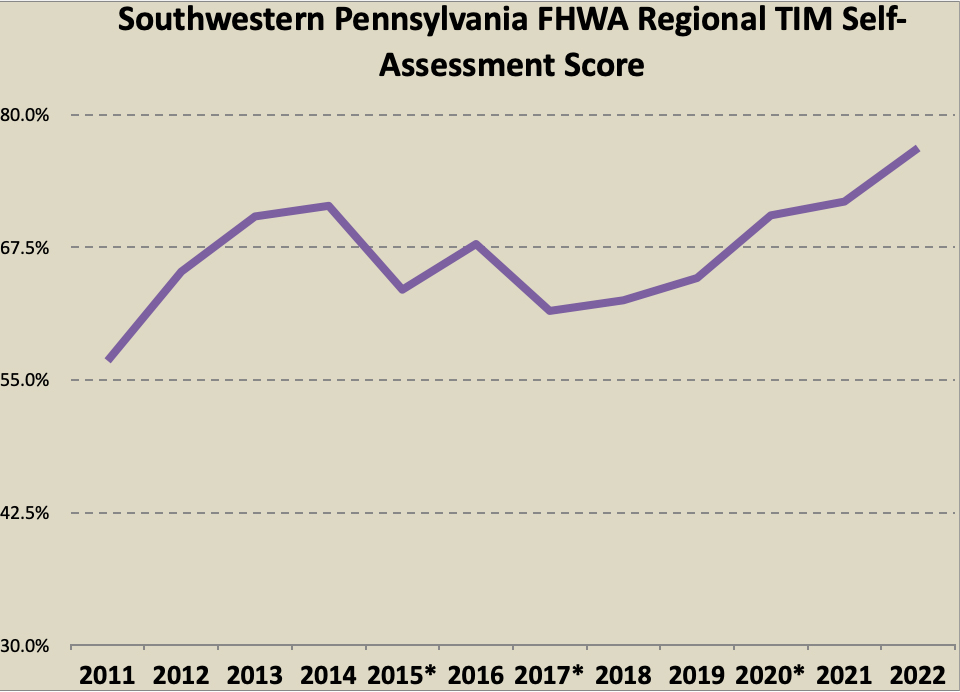
This TIM Self-Assessment provides a formal process for state and local transportation, public safety, and private sector partners to collaboratively assess their TIM programs and identify opportunities for improvement.  The assessment is conducted annually in each of the largest 75 urban areas.  Each year the new assessment is compared against previous years to evaluate *progress in our TIM program. (See below for our progress since 2011)

FHWA TIM Capability Maturity Self-Assessment (PDF)

A line graph is shown tracking the SPC FHWA Regional TIM Self-Assessment Score

* In 2015 and 2017, more specific scoring for each question was added and therefore may see a score decrease.

Resources


Regional Traffic Signal Program

Our Regional Traffic Signal Program provides technical assistance, and potential funding to municipalities throughout our region.

Since 2008, SPC and our planning partners have been assisting local governments with improving traffic signal operations by optimizing traffic signal timings and upgrading existing traffic signal equipment. We have now completed the third cycle of this important regional program. Together the three cycles have invested nearly $11 Million to improve traffic signals in the region and results have yielded $51 of public benefit for every $1 spent in terms of reduced delay, reduced vehicular stops, reduced fuel consumption, and reduced emissions.

A summary of the benefits and costs of this program can be found here.

Visit our YouTube Channel to view Before/After Retiming Videos & Project Summaries

Resources


Transportation Operations & Safety Forum

Our Transportation and Operations and Safety Forum meets 3 to 4 times per year and  brings together traffic engineers, safety professionals, and transportation planners from around the region to collaborate and share information on projects that work toward improved efficiency and safe operation of the transportation system.  We continue to lead planning for safe and effective transportation operations in Pennsylvania

Resources


Congestion Management Process

Federal transportation legislation requires that each metropolitan planning area in the United States have a Congestion Management Process, or CMP.  The CMP is a regional program to address and manage congestion within the 10-county Southwestern Pennsylvania region in order to facilitate the movement of people and goods.

The goal of the CMP is to provide information that helps transportation planners, professionals and others to understand the overall congestion climate in individual corridors and the region. Data on the congestion climate helps us, in partnership with other agencies, to formulate congestion management strategies. Data and information from the CMP benefits the transportation planning process by helping the region focus limited federal transportation dollars where they can have the greatest impact.


Special Studies


Intelligent Transportation Systems

We participate in statewide and national discussions concerning advancements in Intelligent Transportation Systems (ITS), including a statewide connected and autonomous vehicle work group on emerging technologies.

Resources


Regional Operations Plan

We continue to work with our partners to implement initiatives from the seven priority areas contained in the 2019 Regional Operations Plan.

Resources


Highway Safety Improvement Program (HSIP)

The Highway Safety Improvement Program (HSIP) is a core Federal-aid program with the purpose to achieve a significant reduction in traffic fatalities and serious injuries on all public roads, including non-State-owned roads and roads on tribal land. The HSIP requires a data-driven, strategic approach to improving highway safety on all public roads with a focus on performance.  The goals of the program is to address PA Strategic Highway Safety Plan (SHSP), project selection by Data Driven Safety Analysis (DDSA), and HSIP Set-Aside project solicitation. 

2025-2026 HSIP Set Aside Projects.

Resources


Road Safety Audits

We have developed a RSA program for Southwestern Pennsylvania as part of our Transportation Operations and Safety planning efforts.  Road Safety Audits examine of existing or future roads using an independent, multidisciplinary team to identify potential road safety issues and opportunities for proactive safety improvements. SPC integrates safety evaluations into managed funding programs.

Resources


SmartMoves: Long Range Transportation Plan & Transportation Improvement Program

2023 SmartMoves Long Range Transportation Plan Documents

Orange and Grey "Smart Moves For A Changing Region" logo

The SmartMoves for a Changing Region transportation and development plan identifies the region’s priority roadway, transit and multimodal transportation improvements programmed for advancement over the next 25-30 years.

Publications and Resources

2025-2028 Transportation Improvement Program (TIP)

The region’s long range transportation plan is implemented with a series of shorter-term investment plans, known as Transportation Improvement Programs, or TIPs. Each TIP is a step along that 25-year investment in our region’s future.

The 2025-2028 TIP is comprised of projects and programs that serve multiple transportation modes and connections in our region.

Publications and Resources


Public Transit-Human Services Coordinated Transportation Plan (CTP)

Federal transit law requires that projects selected for funding under the Enhanced Mobility for Individuals and Individuals with Disabilities Program (49 U.S.C. 5310) be “included in a locally developed, coordinated public transit-human services transportation plan.” The plan is required to be “developed and approved through a process that included participation by seniors, individuals with disabilities, representatives of public, private, and nonprofit transportation and human services providers and other members of the public” utilizing transportation services.

Transportation Technical Committee (TTC)

Our TTC deals exclusively with technical issues relating to transportation. It makes recommendations to SPC and the Policy Committee regarding the Transportation Improvement Program, transportation-related air quality plans, and transportation issues.

The Committee includes the planning directors of the ten SPC member counties, the City of Pittsburgh, and representatives of PennDOT Central Office, Pennsylvania DEP, and the PGH Regional Transit. Nonvoting members of the Committee include PennDOT District Offices, FHWA, FTA, EPA, and the Allegheny County Bureau of Air Pollution Control.

Resources